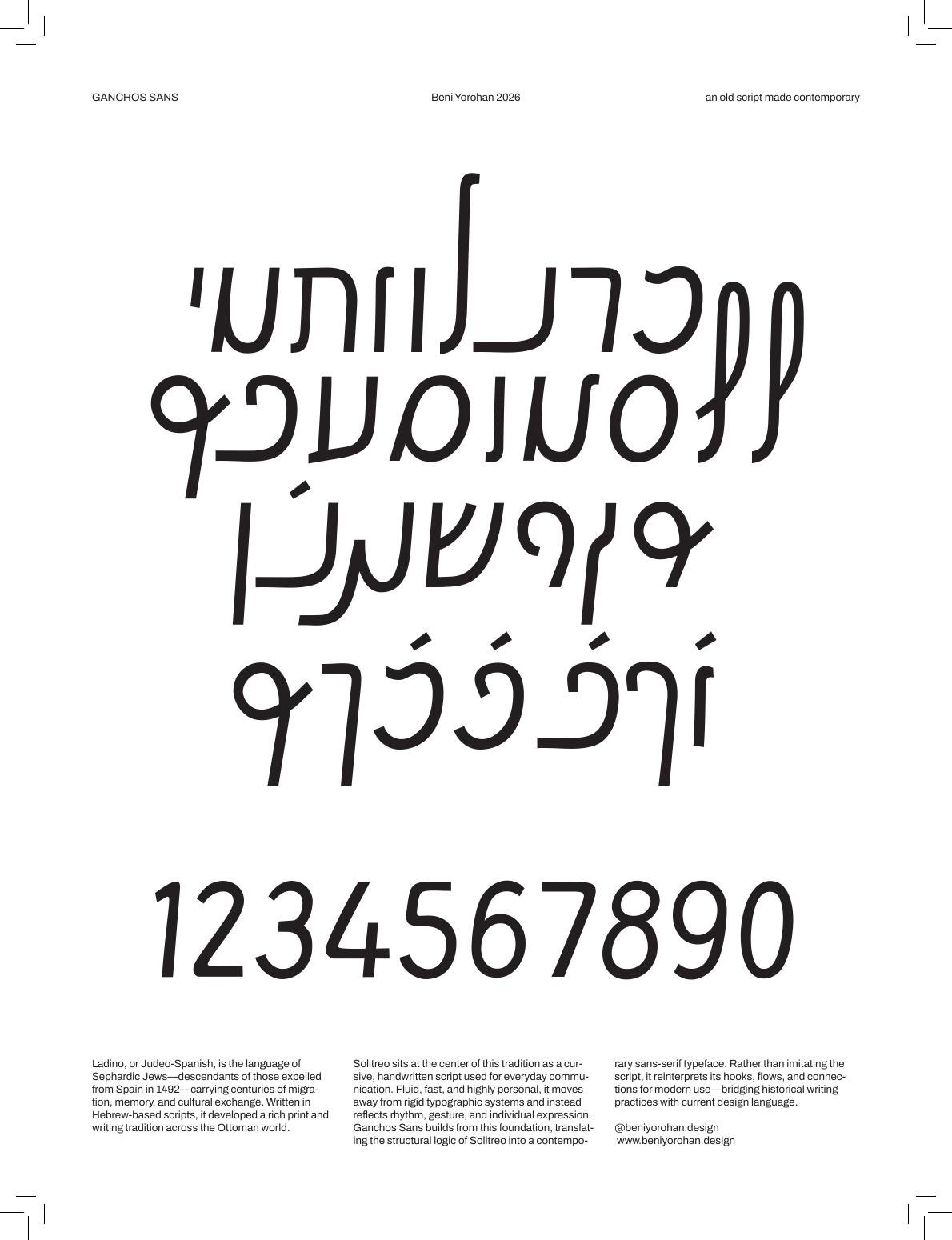
Ganchos Sans is a contemporary sans-serif typeface built from Solitreo — the cursive, handwritten script Sephardic Jews used for centuries to write Ladino, and which today almost nobody can read. What started as a magazine assignment became a year-long independent study: archival research on two continents, interviews with the people keeping the language alive, and finally a typeface that translates the structural DNA of an endangered script into a modern system — along with a 112-page book, a poster series, a woven rug, and a transliteration guide. An old script made contemporary.
Every part of this project — the research, the typeface, the book, the objects — is an answer to that one question. Not preservation for its own sake, and not nostalgia: I wanted to understand what these forms can still do, how a script that history nearly erased could inform new typographic systems today instead of just sitting in an archive.
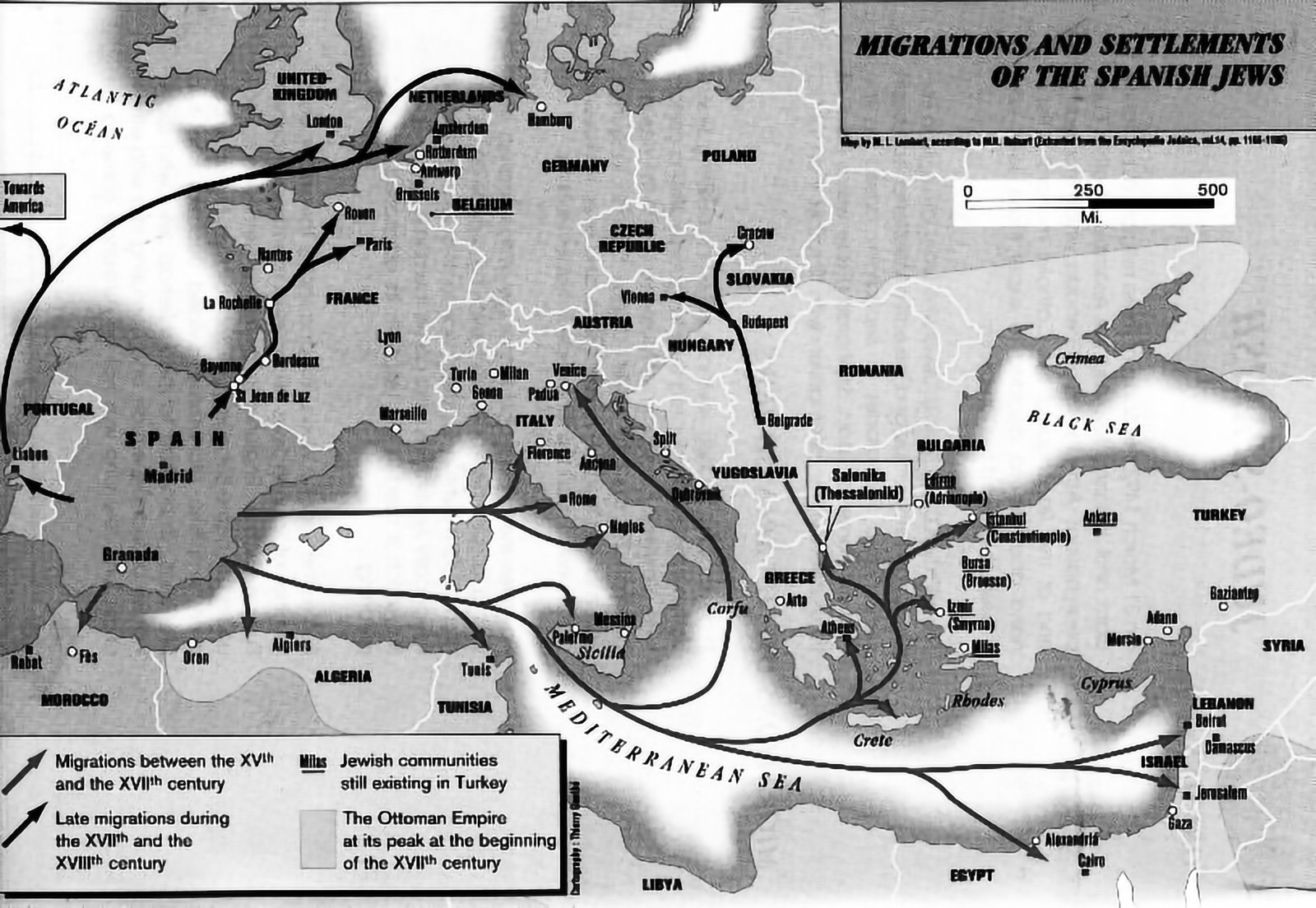
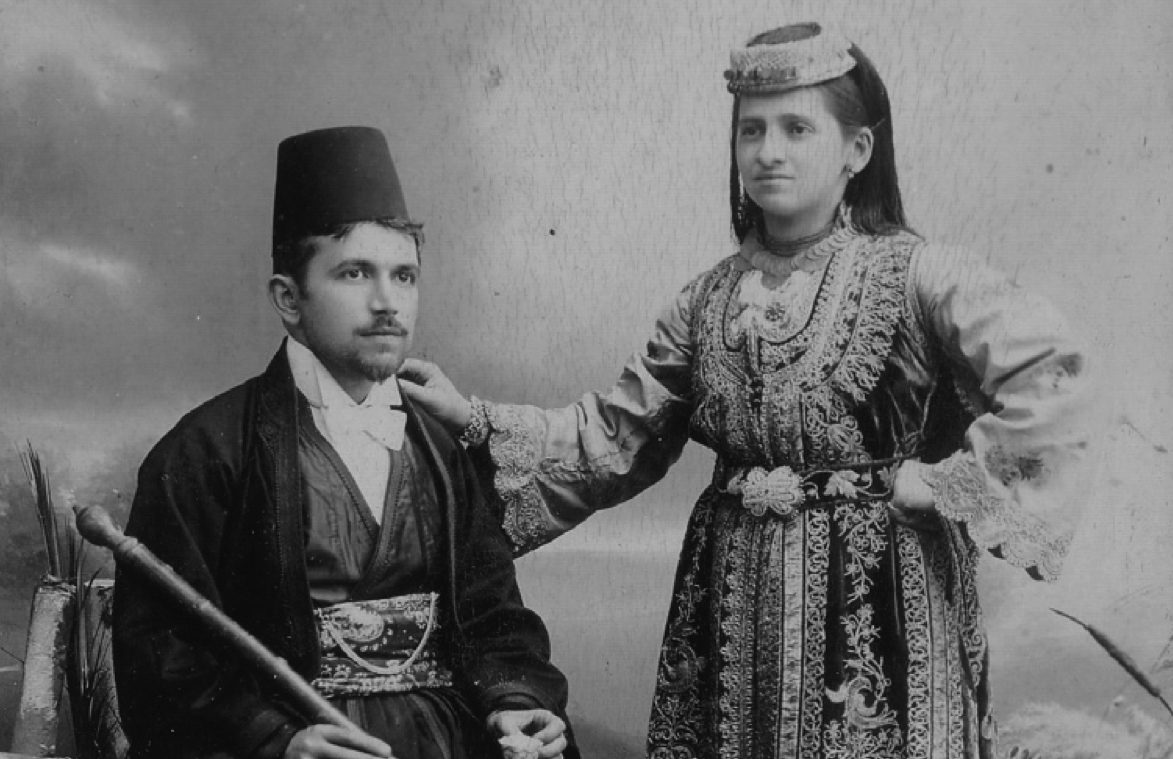
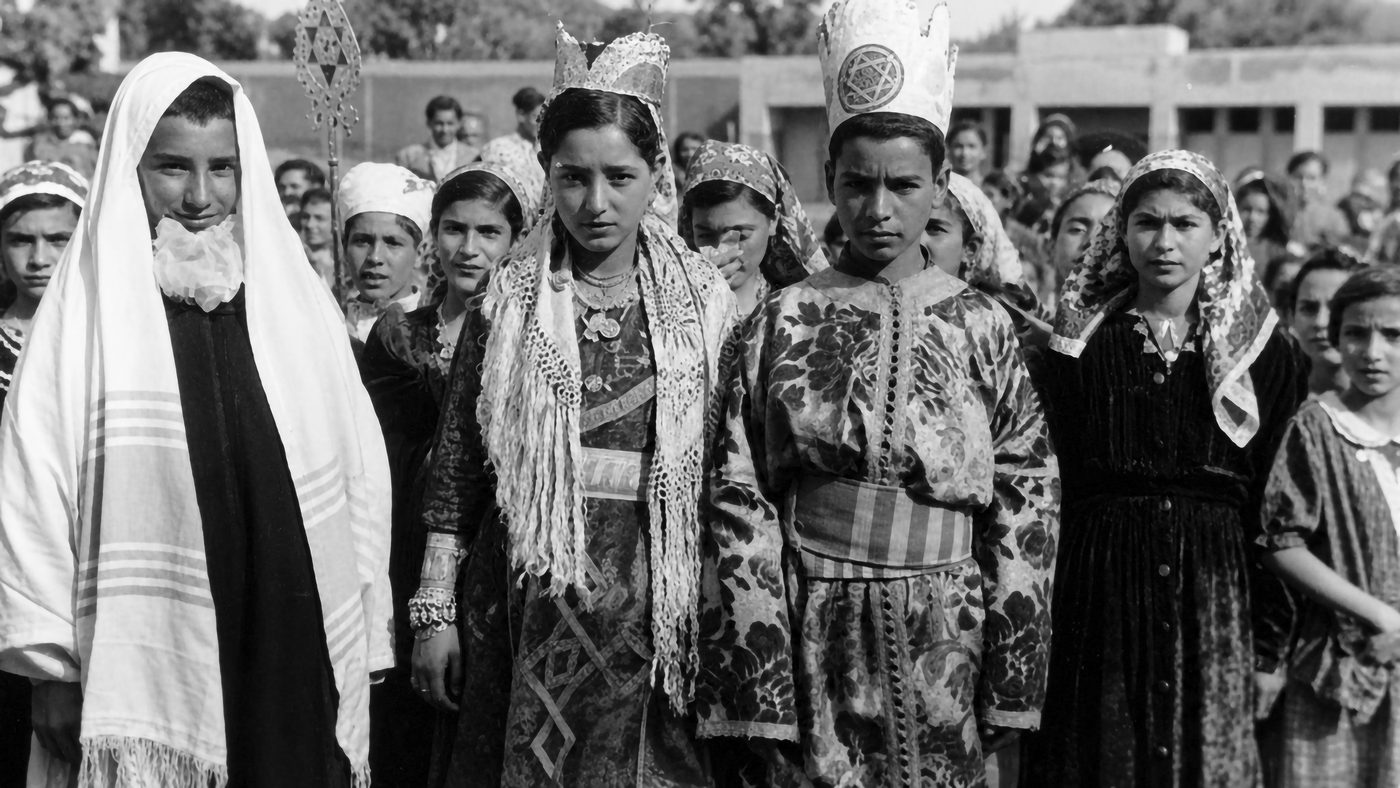
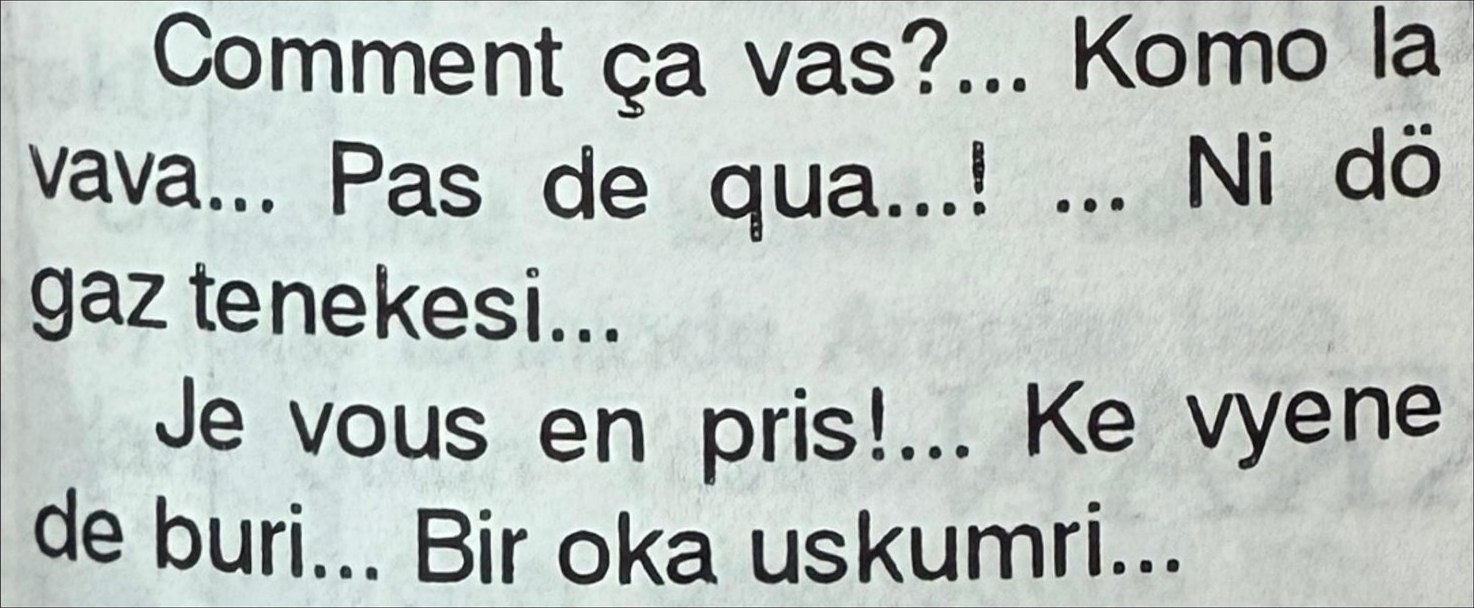
Ladino — Judeo-Spanish — is the language of the Sephardic Jews, descendants of those expelled from the Iberian Peninsula in 1492. But it wasn't carried out of Spain ready-made. The exiles spoke many dialects — Galician, Catalan, Aragonese, Castilian — and it was in the melting pot of the Ottoman Empire that those dialects fused into one language, absorbing Turkish, Greek, Italian, French and Hebrew along the way. A Romance language, born in diaspora, held together by memory.
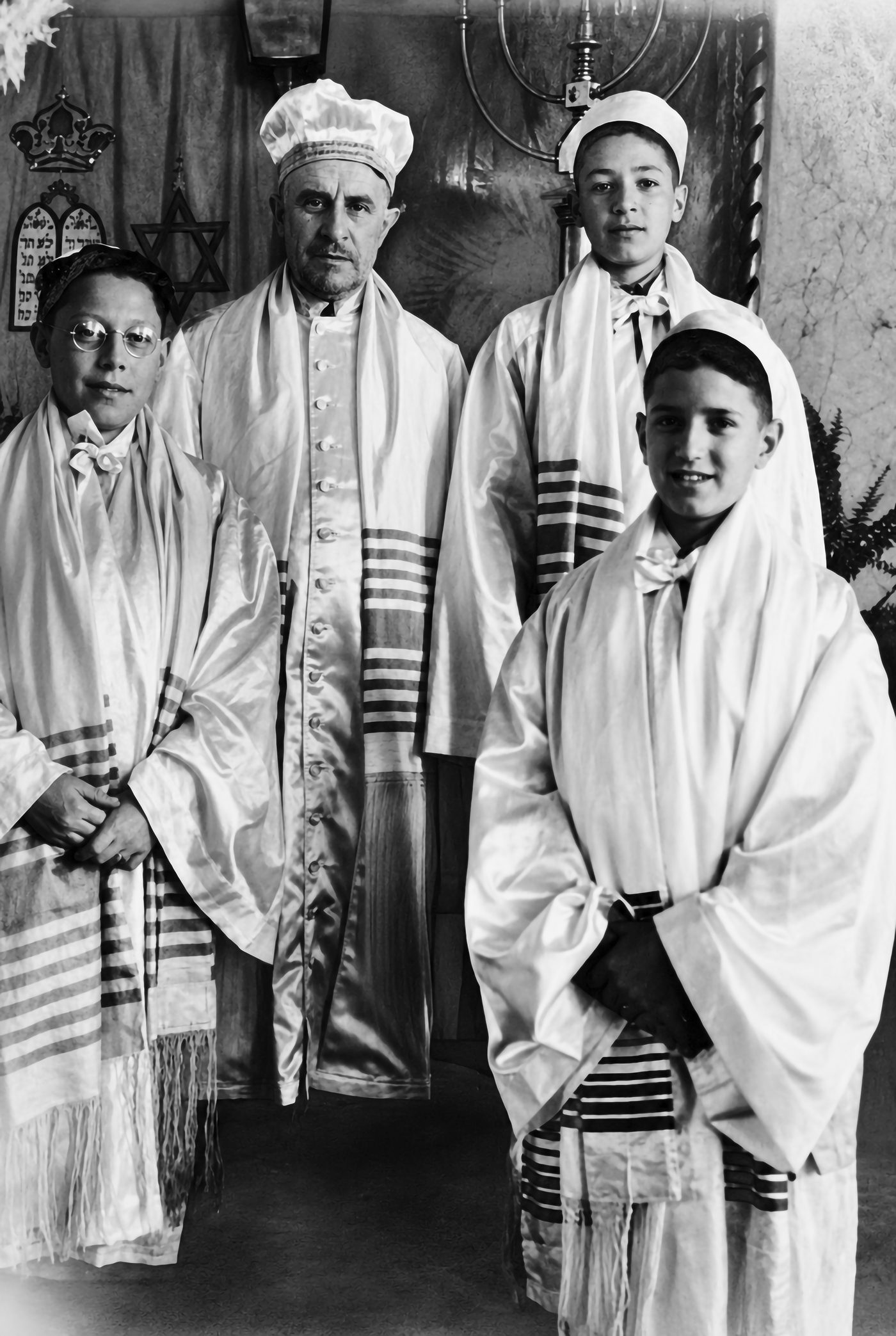
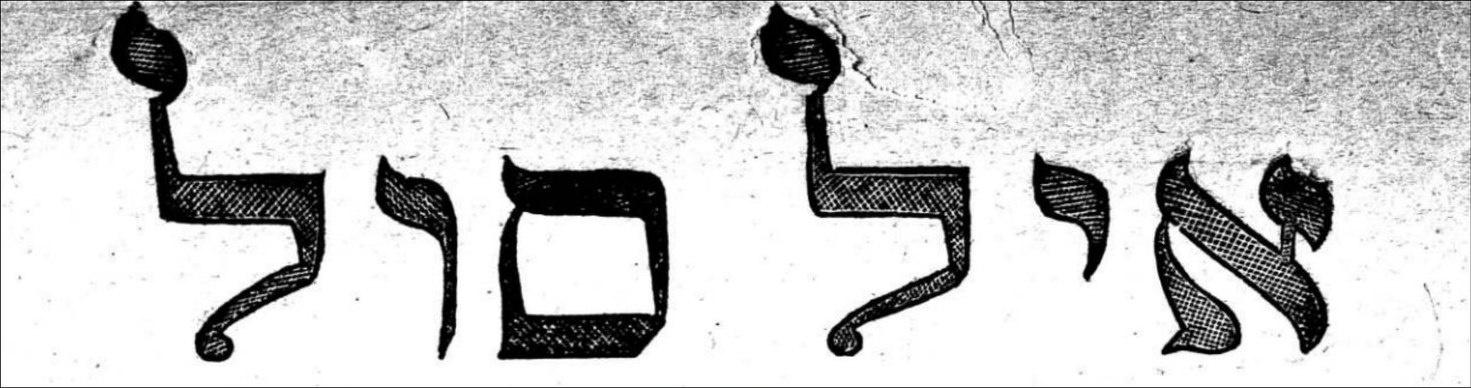
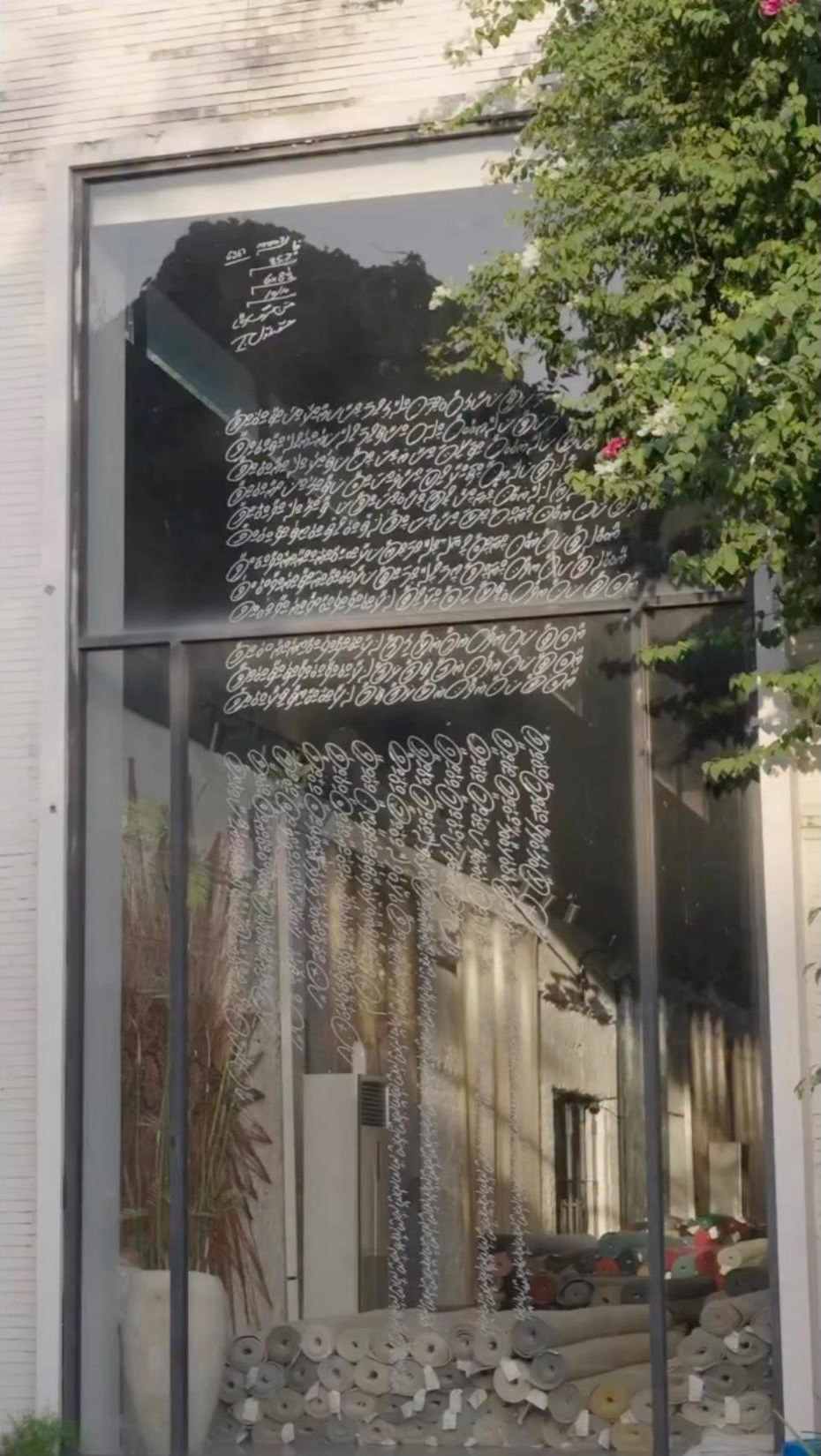
For centuries Ladino was written in Hebrew-based scripts: Rashi for print, and for handwriting a fluid cursive called Solitreo. Among Sephardim it went by a simpler name — ganchos, "hooks" — because from a distance the writing looks like rows of small hooks linking into each other. It was the script of letters, shopping lists, love notes, and community records: fast, personal, and intimate. And unlike Rashi, it belonged to Ladino alone.
Then the twentieth century happened to it. French-language Alliance Israélite schools made Ladino feel like "dirty pajamas thrown in the corner" next to French. The 1928 "Citizen, Speak Turkish!" campaign pushed it out of public life. The Holocaust destroyed Salonika, home to the largest Solitreo-writing community in the world. What survived shifted to the Latin alphabet. Today Ladino is written phonetically in Latin characters — and Solitreo has become functionally unreadable, even to the community it belongs to. Family letters, postcards, entire archives: locked behind a script with almost no living readers.
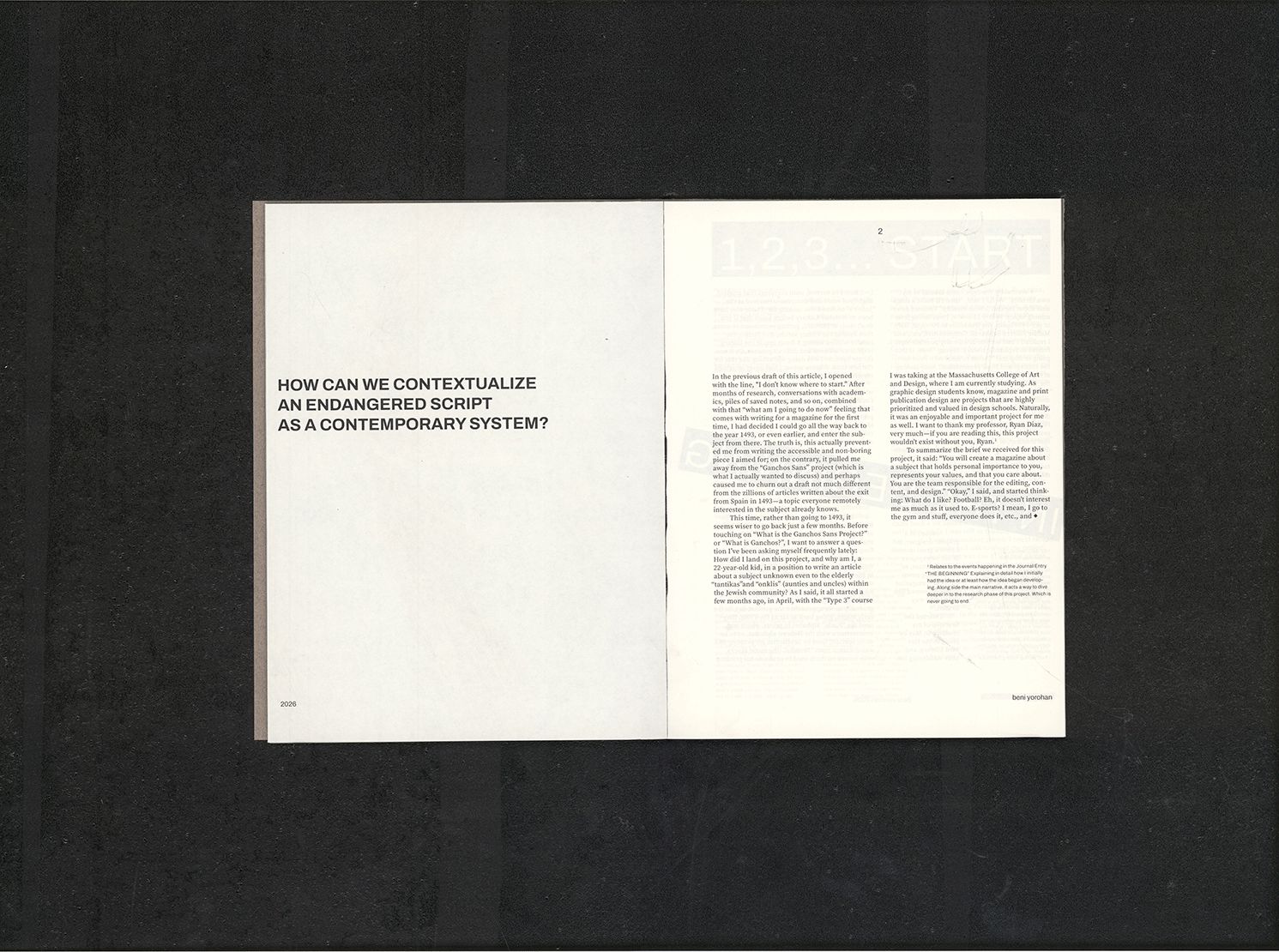
This project wasn't supposed to exist. It started in a Type 3 course at MassArt with a brief for a self-curated magazine "about a subject that holds personal importance to you." I chose Turkish Jewish identity — and before I knew it I was listing every topic in Sephardic history and losing the plot entirely. My professor, Ryan Diaz, looked at the scope and told me, more or less: forget the magazine — you like this too much. Do it as an independent study, and I'll be your mentor. That one conversation turned an assignment into a year of my life.
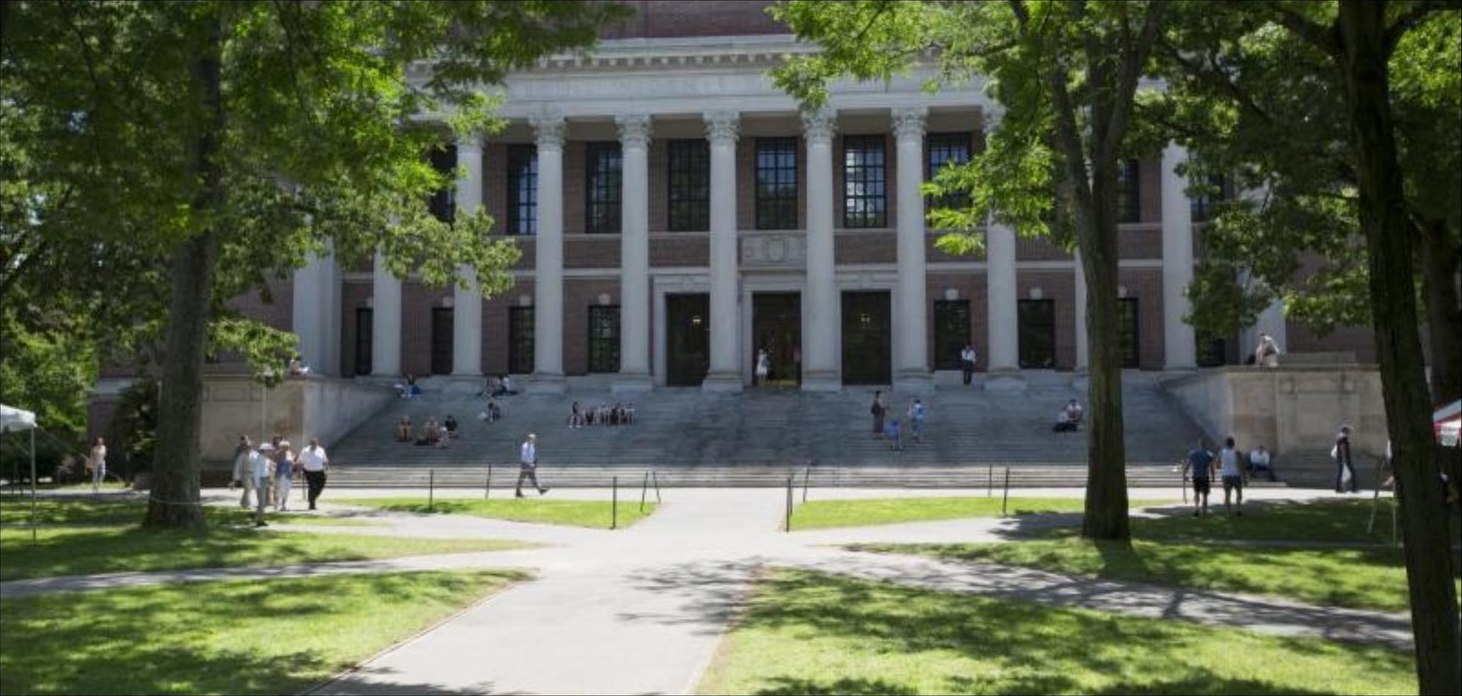
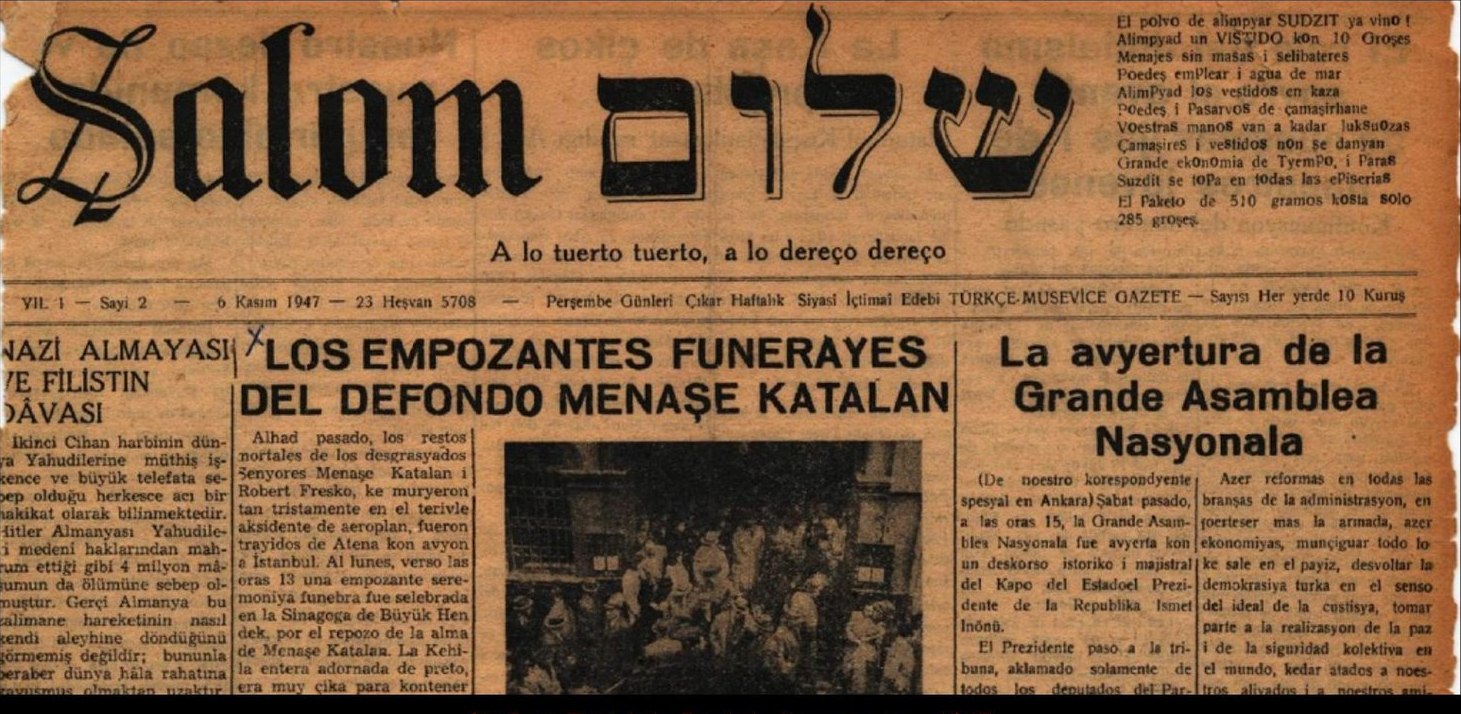
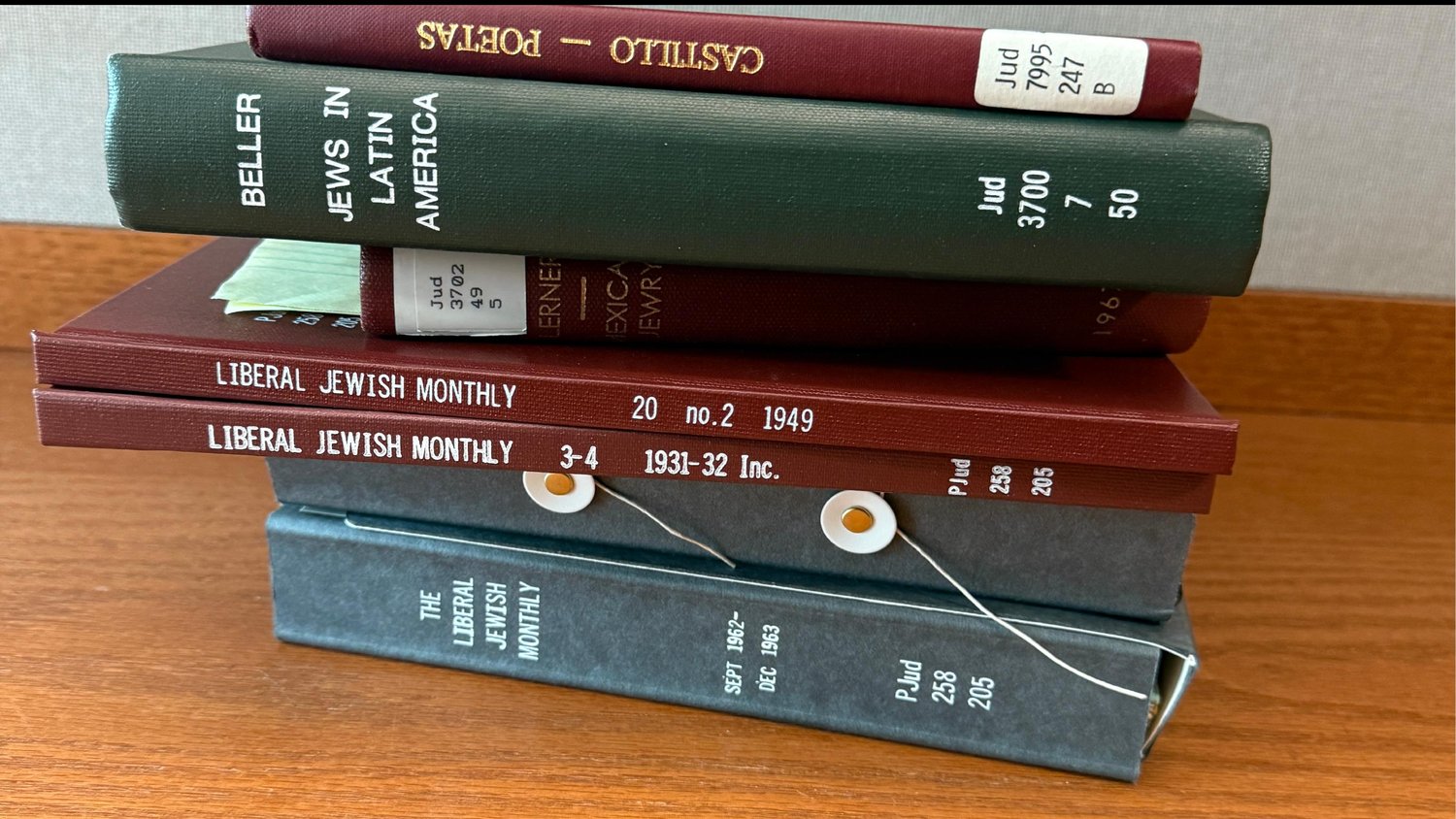
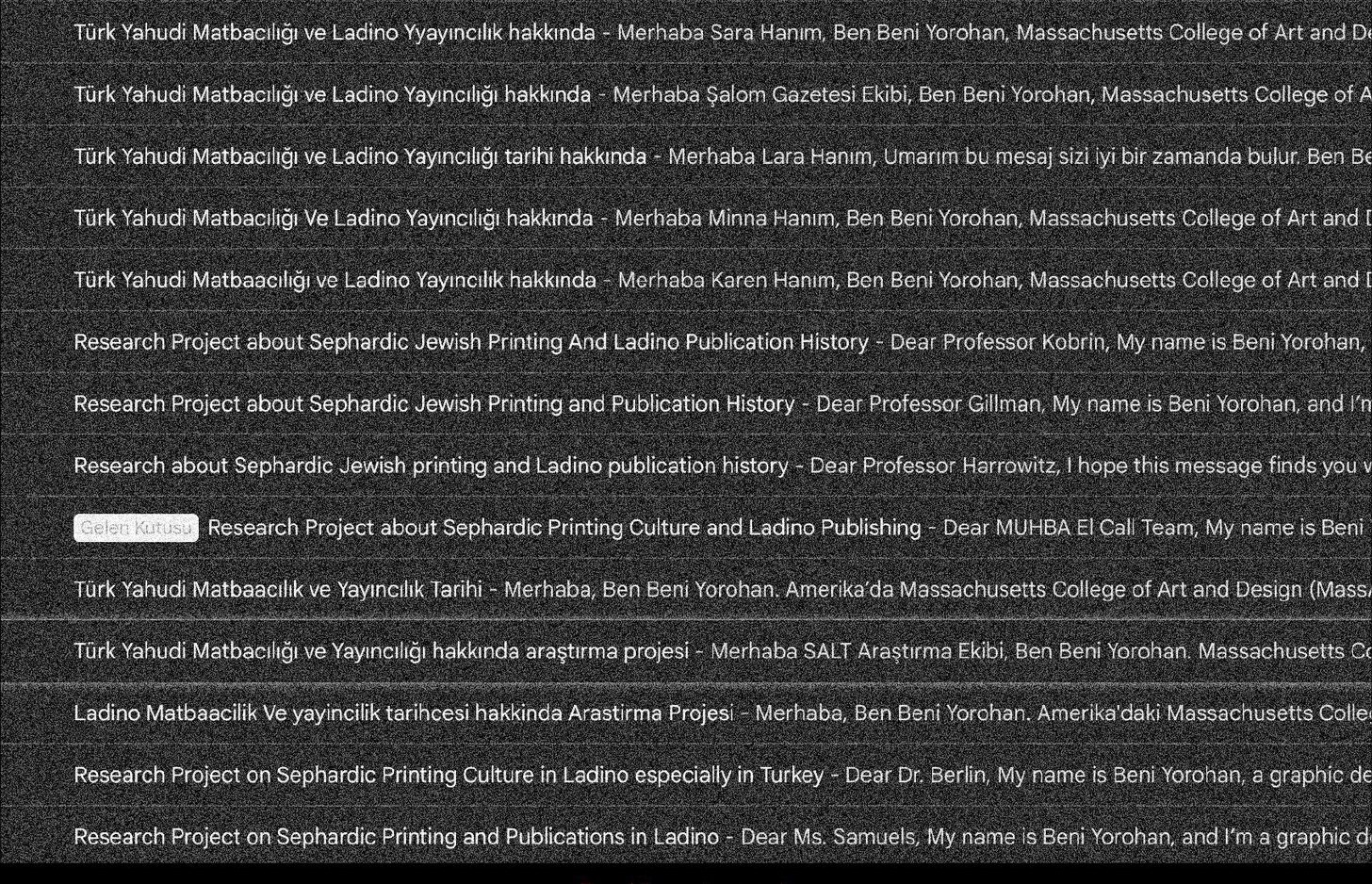
The research started at Harvard's Widener Library, in narrow unlit corridors that smelled slightly of mold, eight floors down to the Judaica section. I sat there for hours with old Ladino newspapers — El Sol, La Luz, La Nationale, Şalom, El Amaneser — and watched, issue by issue, the language's presence shrink and its alphabet drift from Rashi to Latin. At the same time I was emailing my way through the institutions of the Turkish Jewish community: archives, museums, foundations, researchers. Most of the outreach emails went out in a single twenty-minute burst — and within an hour, Karen Sarhon had replied.

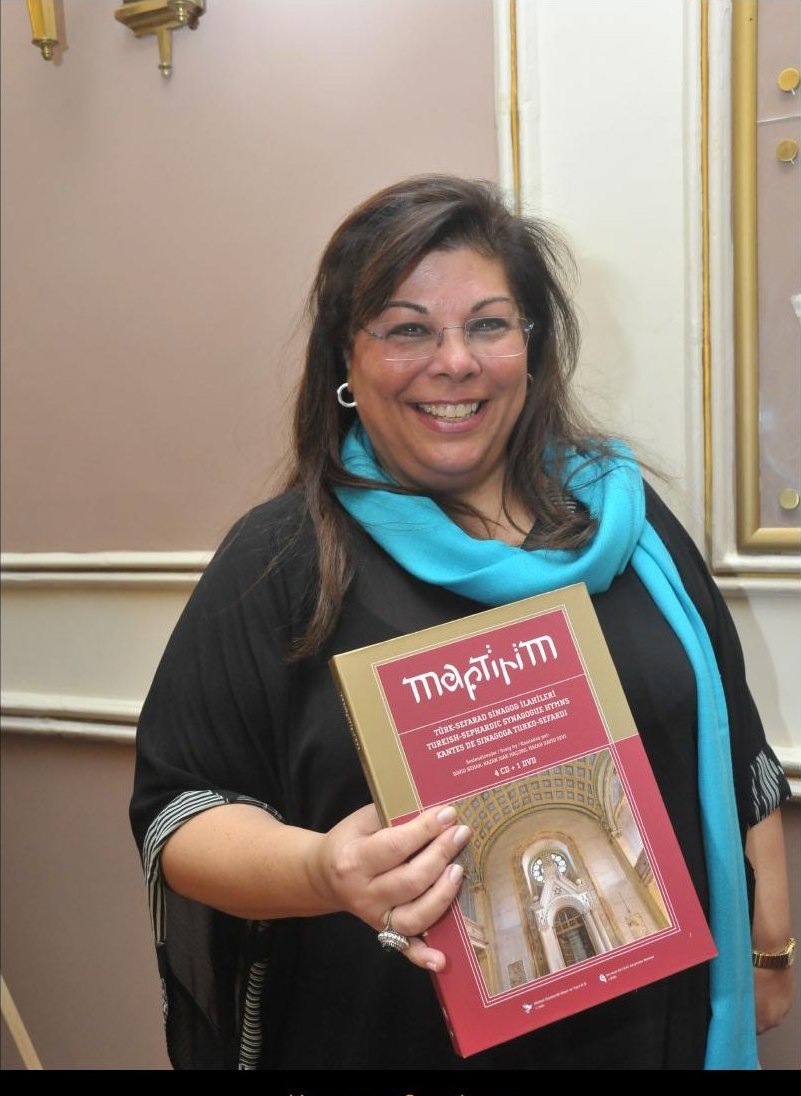
In Istanbul the project stopped being archival and became personal. I met Karen Sarhon — coordinator of the Ottoman-Turkish Sephardic Culture Research Center and editor of El Amaneser, one of the last Ladino publications on earth. Over three hours and a cup of Turkish coffee she walked me through the cultural evolution of Ladino: how it formed in the Ottoman melting pot rather than arriving from Spain, how the French schools and the 1928 campaign wore it down, what its culinary and musical traditions still carry. And she introduced me to the script the people called ganchos. That was the lightning bolt. It looked Arabic, it read like Hebrew, and it belonged to my own culture — yet I had never seen it before.
The interviews kept going: hours of recordings, transcripts, voices. Through the community I reached Benni Aguado — my namesake, one of the last people on earth whose native language is Ladino — who answered my questions in a Ladino you can still hear the Bronx in, and later checked my letterforms sketch by sketch. I studied Bryan Kirschen's LadinoType project, which digitized Solitreo faithfully, and consulted Defne Özozer, a doctoral researcher of Ottoman-era languages, on which curves of each letter were structure and which were a writer's flourish.
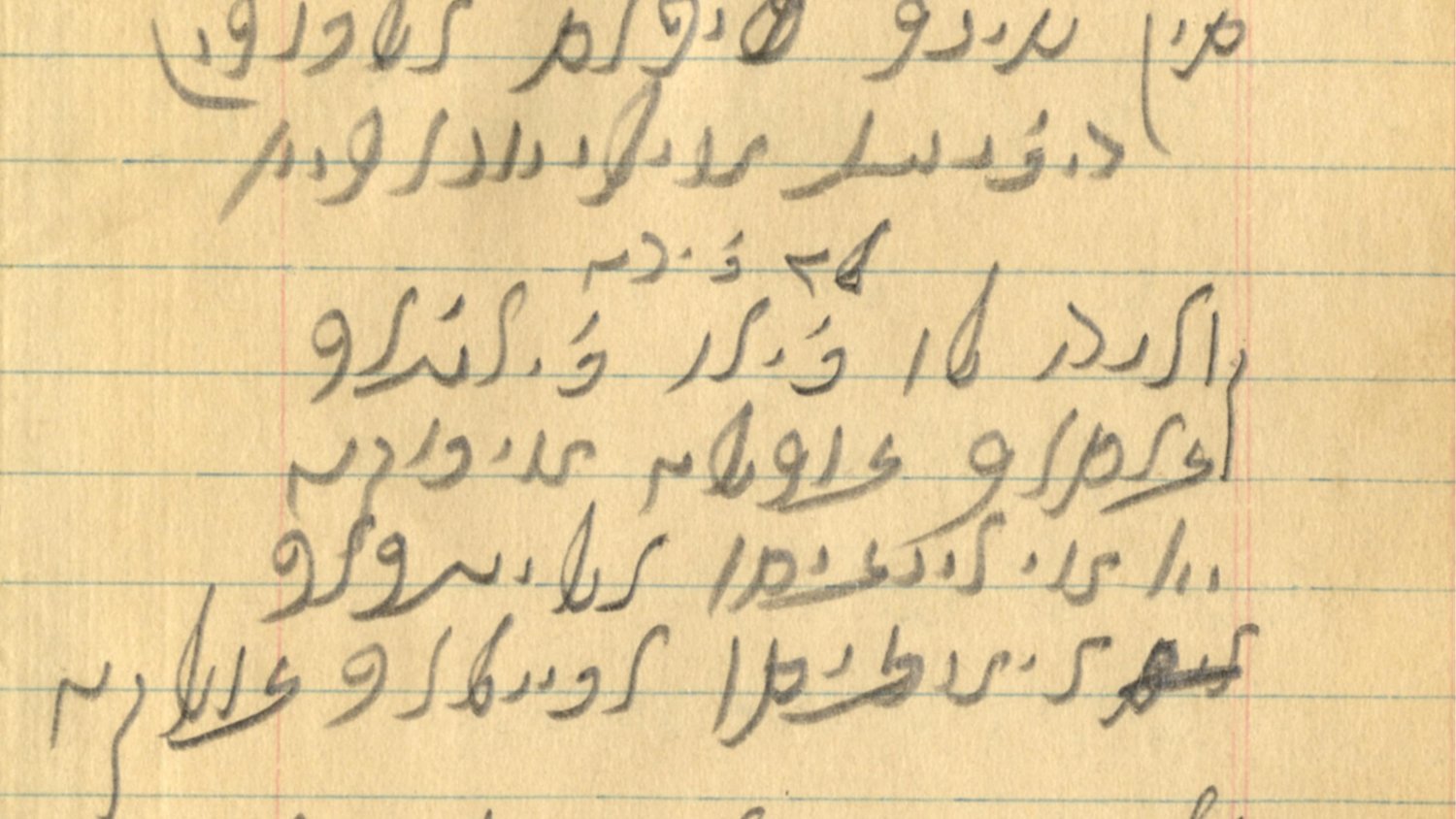
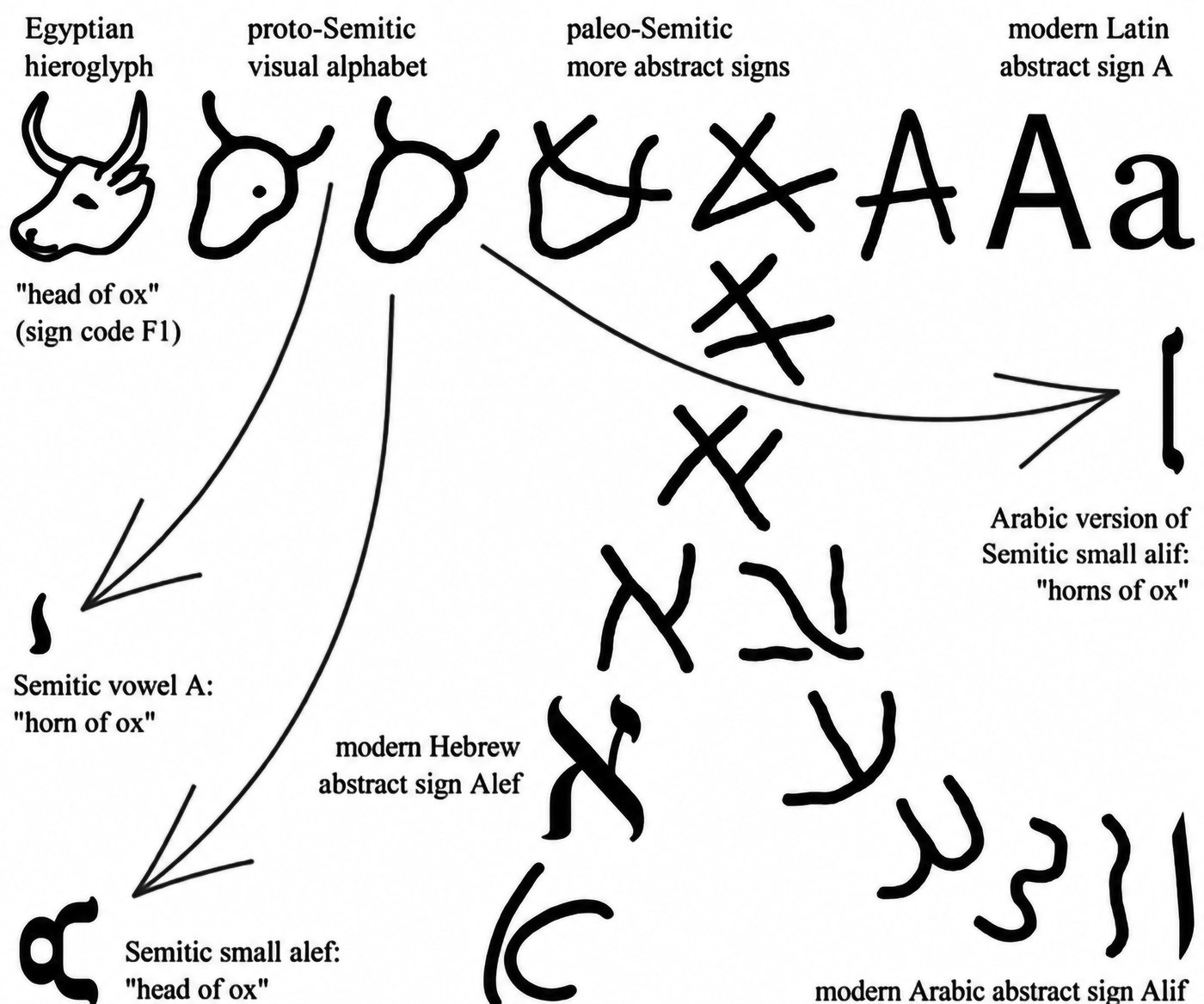
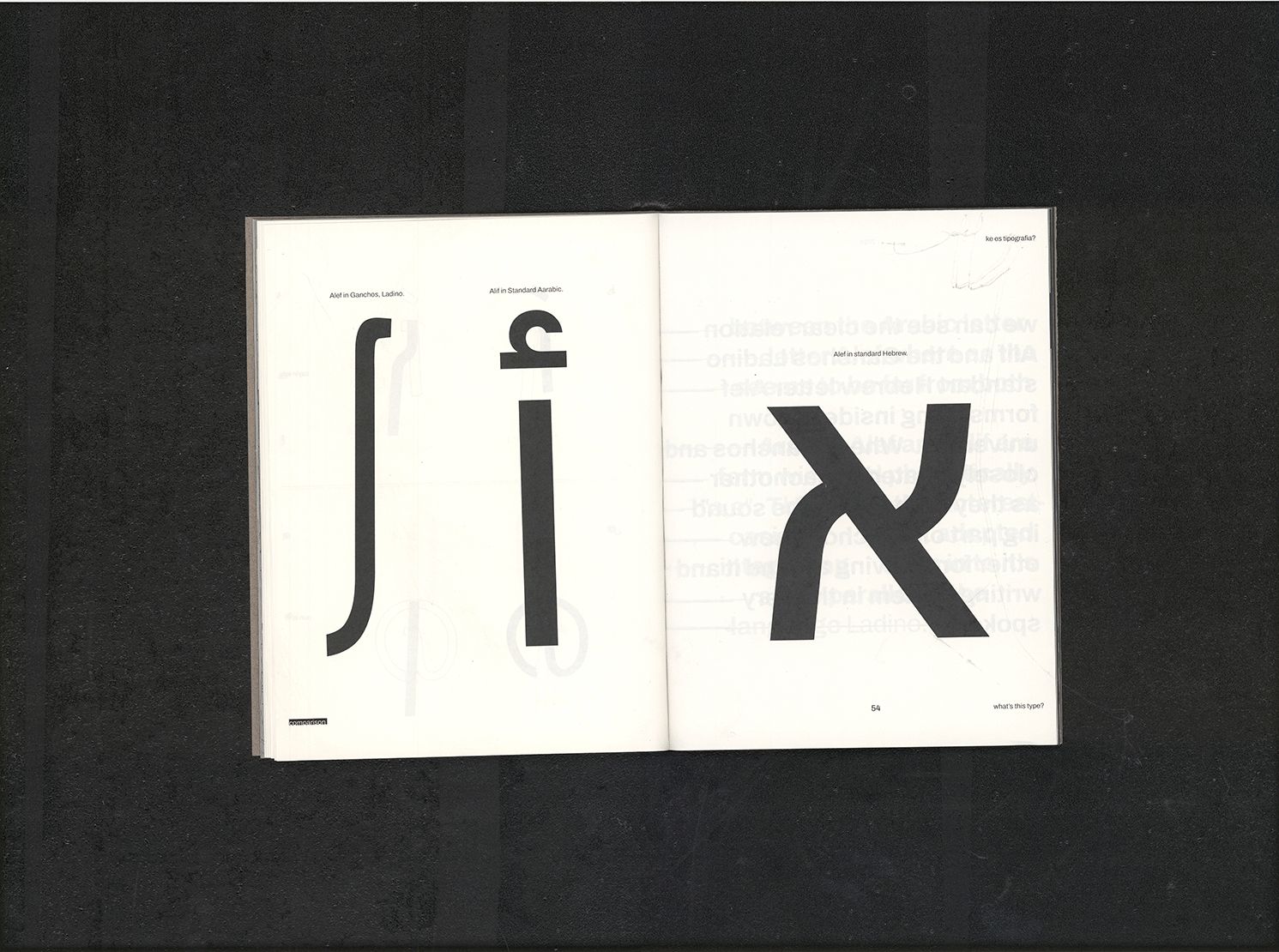
Solitreo is a strange and beautiful contradiction: a Semitic script that existed only to write a Romance language. It could not be used for Hebrew, Turkish, or anything else — it belonged to Ladino alone. Its forms carry the trace of Andalusia, where Hebrew and Arabic lived side by side for three hundred years: the Ganchos alef resembles the Arabic alif far more than the Hebrew alef, and the whole script flows with an Arabic-like cursiveness that modern Hebrew handwriting never had.
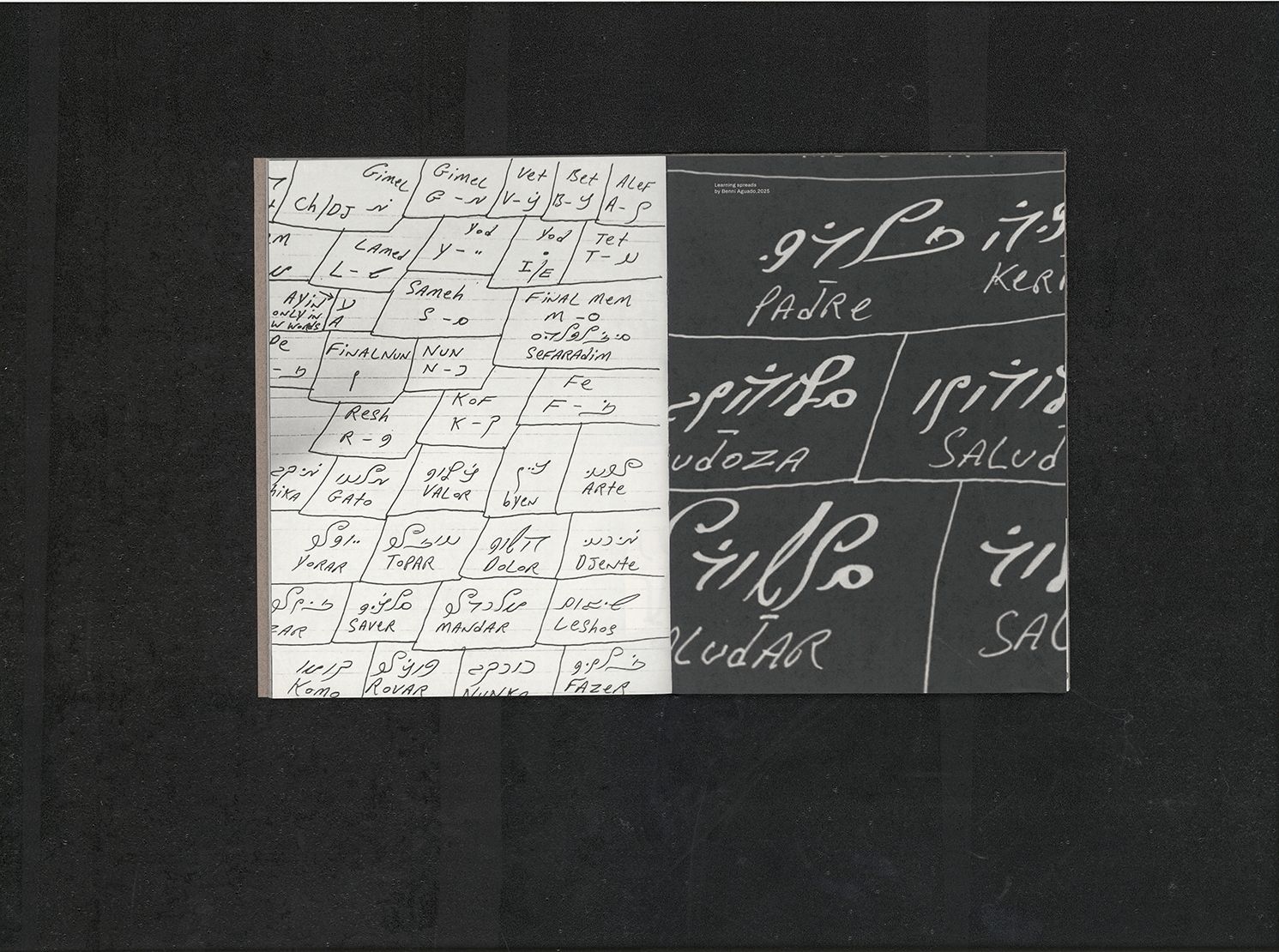
Because Solitreo was never turned into type, it survives only in handwriting — poems, rabbinical records, letters, notes on the backs of family documents. Reading it meant learning it letter by letter from manuscripts, alphabet charts, and the people who still remember it. The most important source sat closer than any archive: a letter from 1961, written entirely in Solitreo, that no one in my family could read anymore.
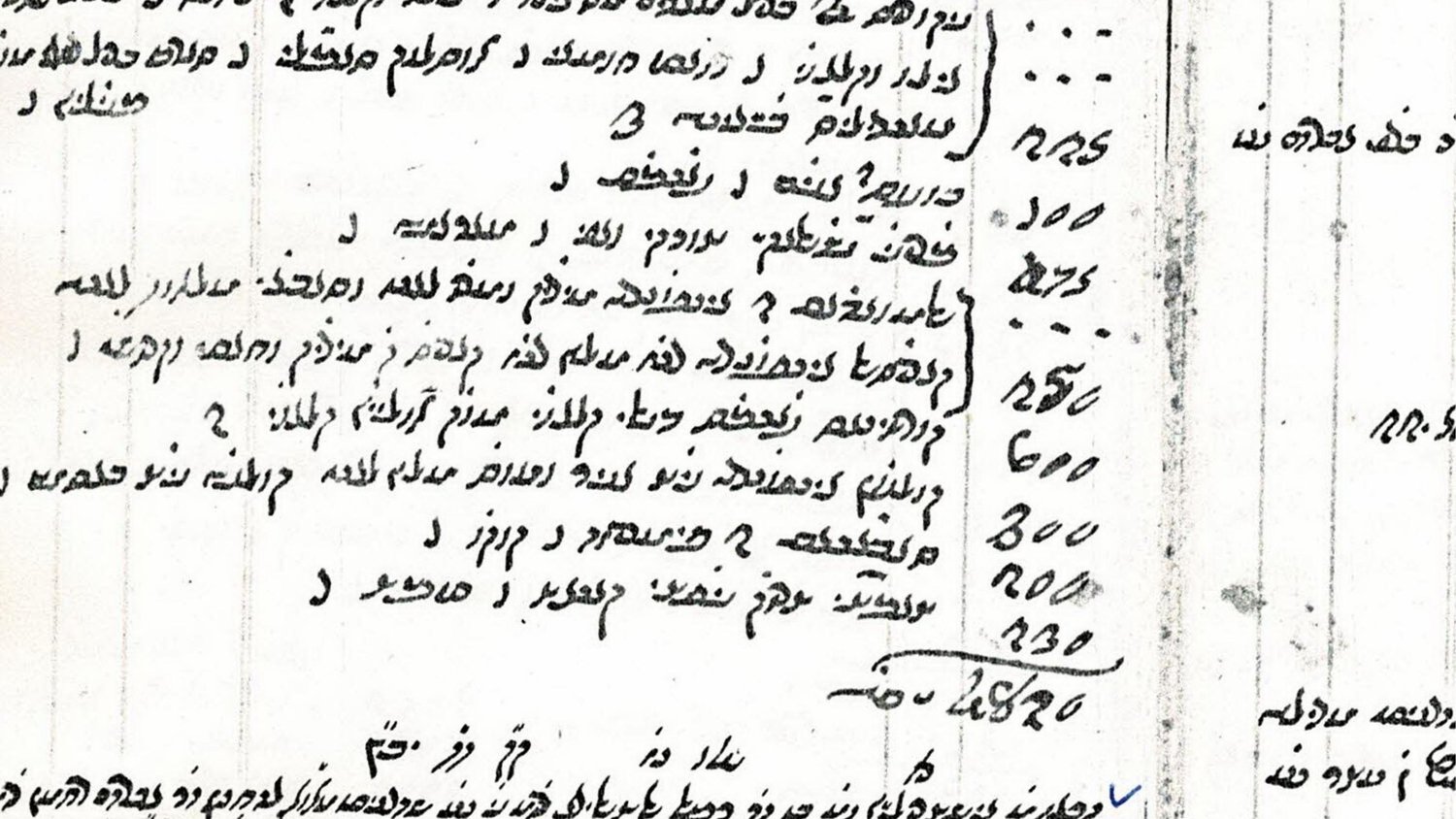
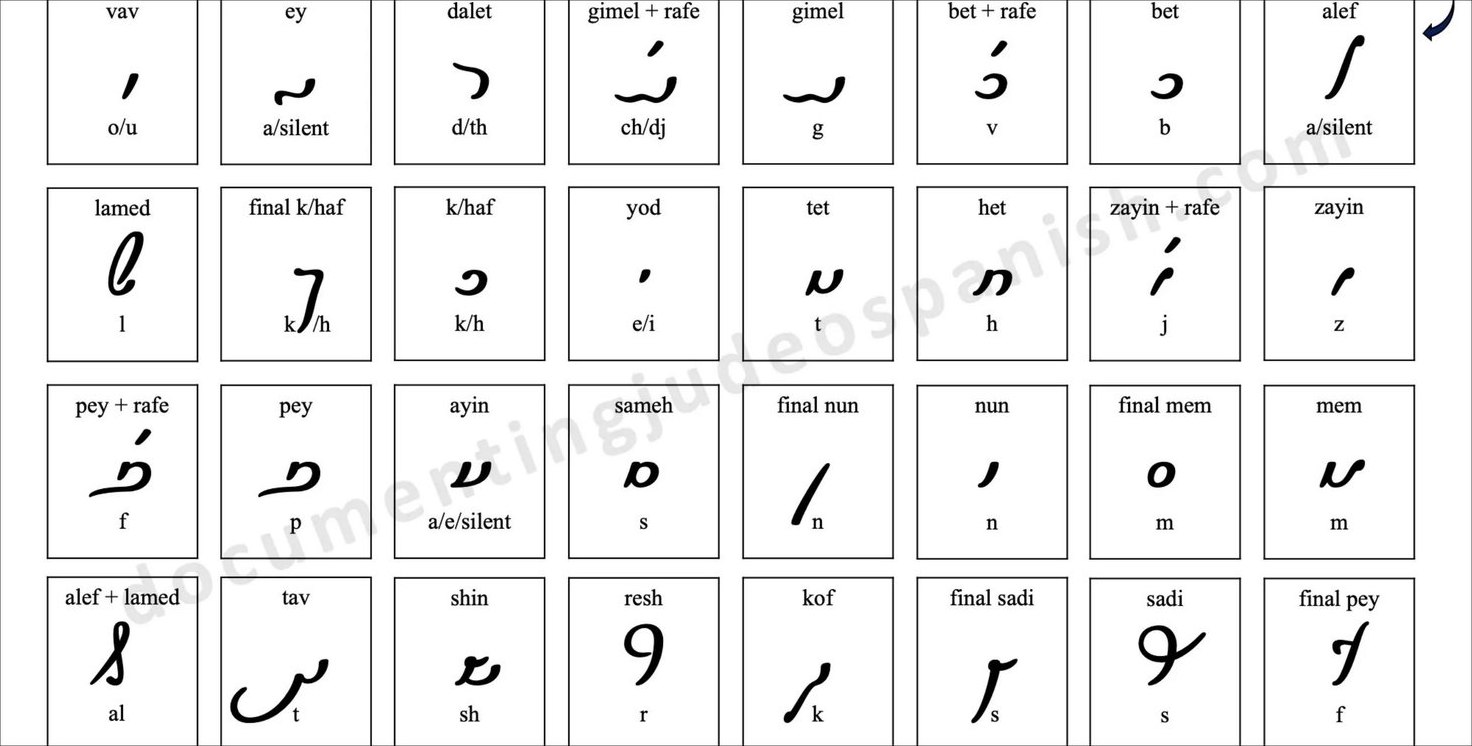
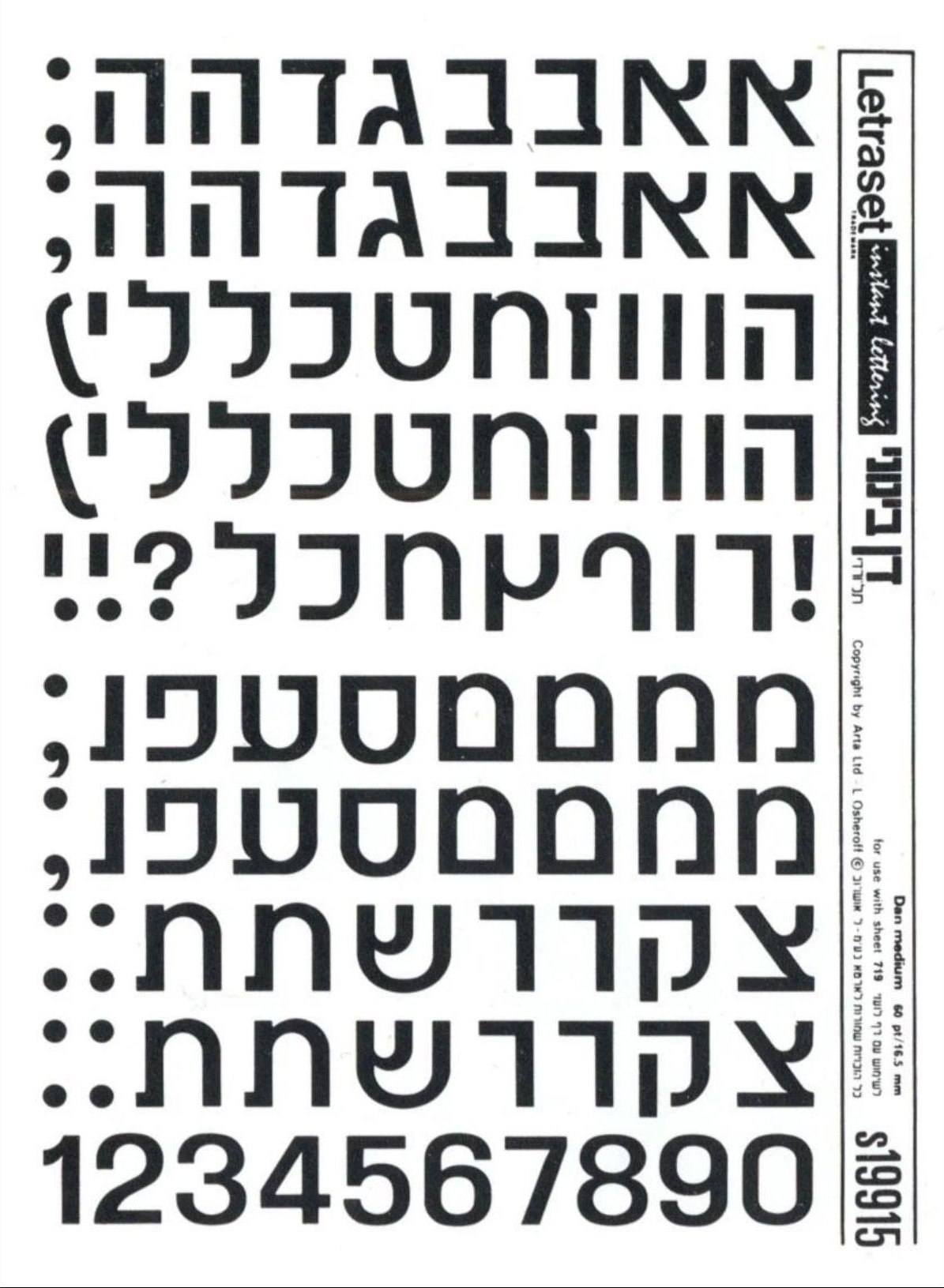
The rule I set for myself: reinterpret, don't imitate. Bryan Kirschen's LadinoType had already preserved Solitreo's handwritten form faithfully — repeating that would add nothing. What didn't exist was a Solitreo that could live in the present tense: a modernized, simplified form that falls into the sans-serif category the way Latin scripts got to over two centuries of refinement. Solitreo never got its typographic evolution. Ganchos Sans is my attempt to give it one — a first.
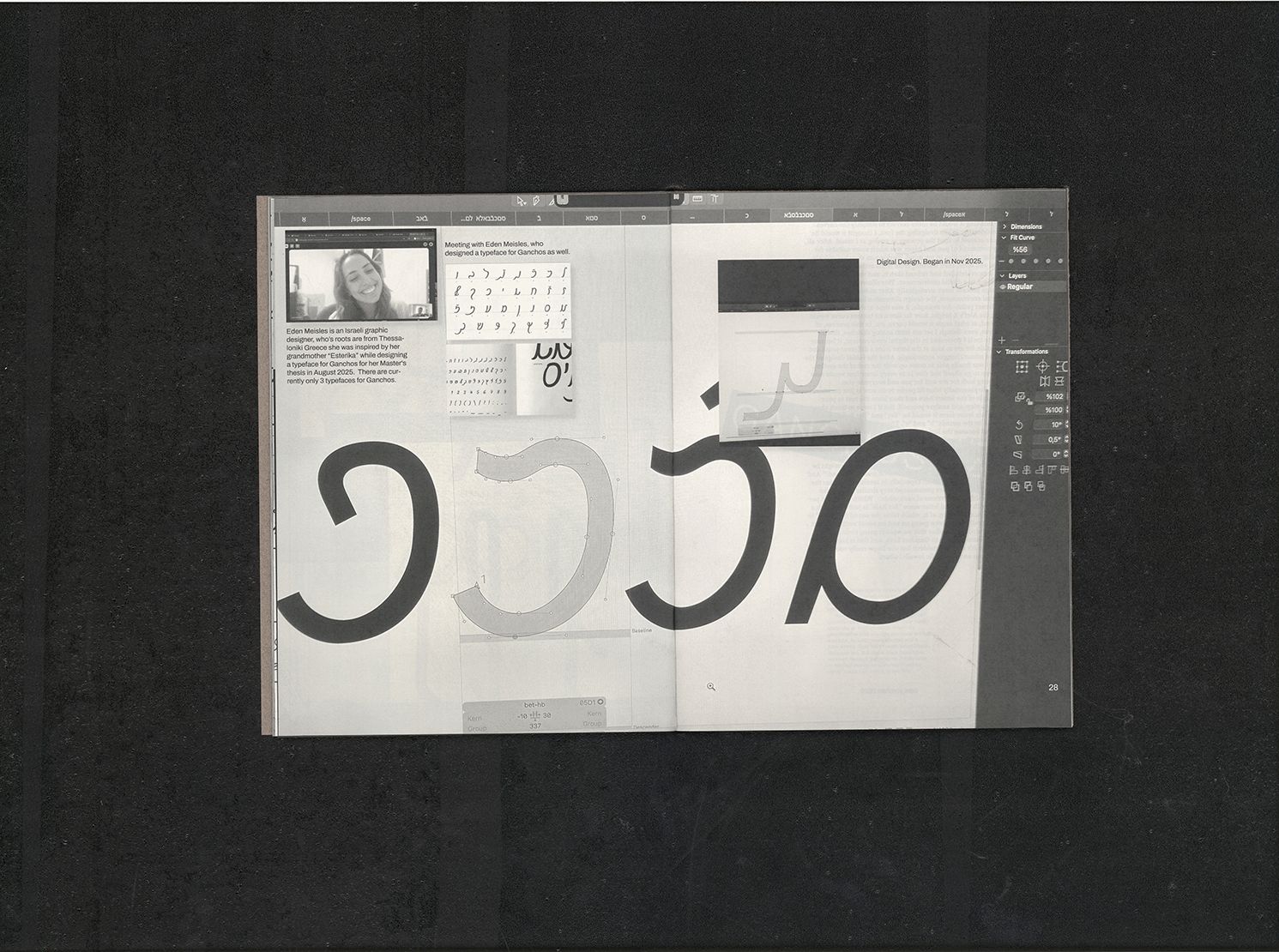
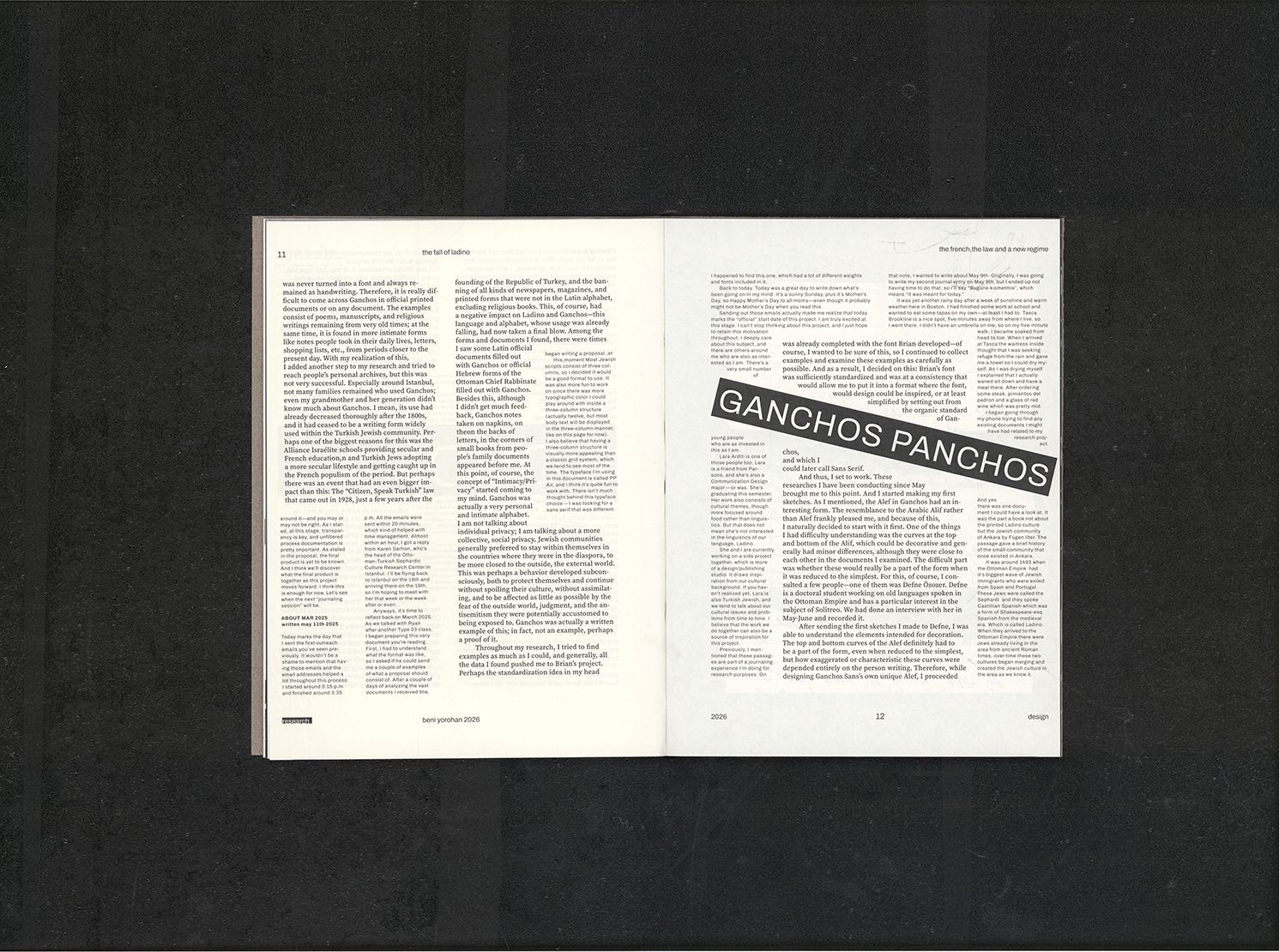
The process started analog, because the script itself is analog. Pen and paper, trial and error against the scanned source material — the alef first, since its sweeping curves posed the hardest question: which are structure, and which are a writer's flourish? Working with Defne, I simplified hard, keeping only what makes each letter itself. Benni Aguado checked the sketches over WhatsApp; I also brought the drawings to Scott-Martin Kosofsky, the book designer and Hebrew typography scholar, for a working session on the system's logic.
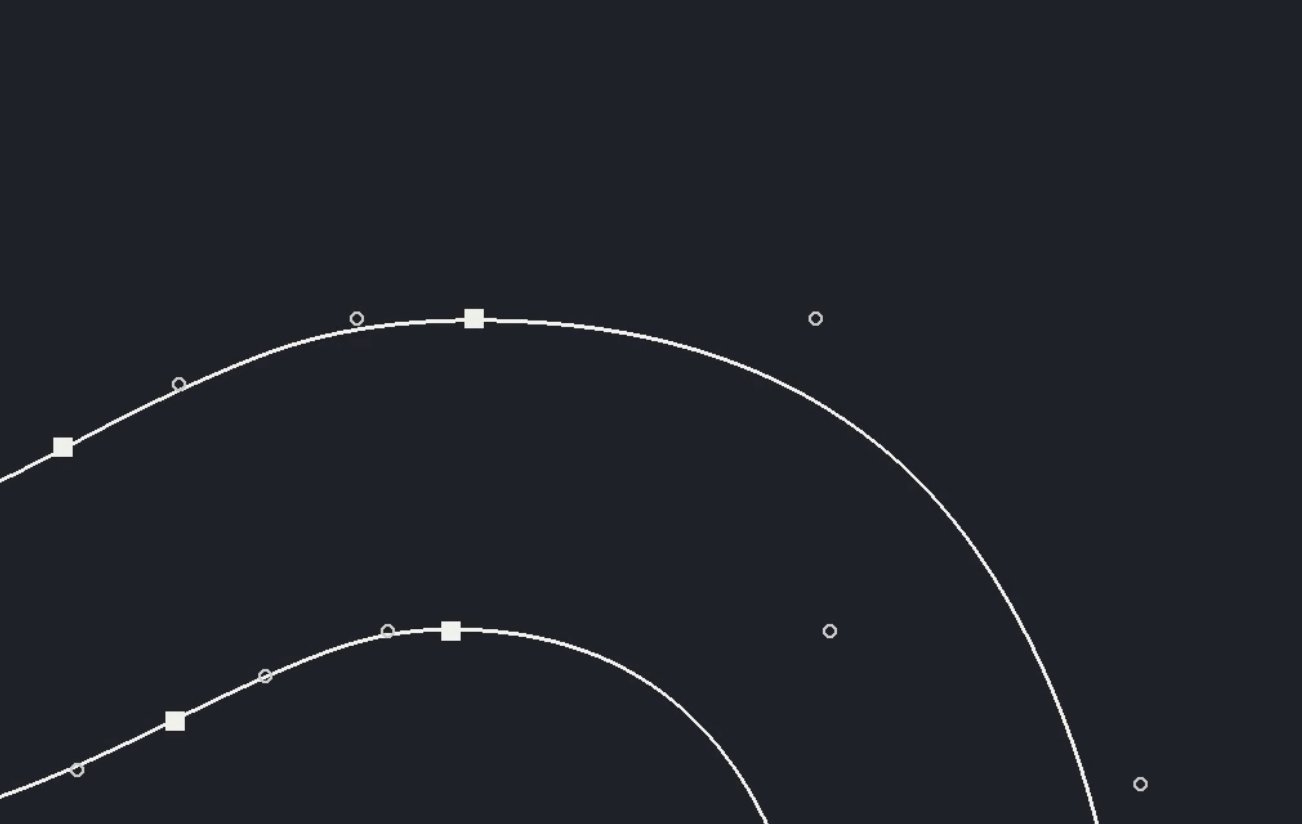
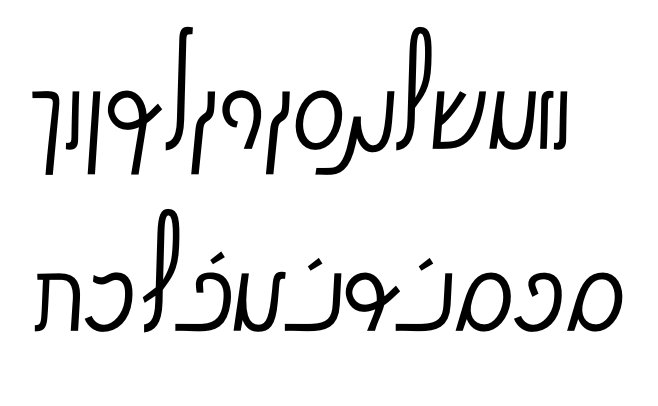
Then into Glyphs, where the typeface went through eight versions. Monolinear strokes, simplified terminals, consistent x-height logic — but keeping the parts of the writing tradition that carry meaning: five final forms, the rafe variants that turn bet into vet and pe into fe, and the alef-lamed ligature, one of Solitreo's signature fusions. Because Ladino, unlike Hebrew, spells out every vowel, the typeface is built for a fully phonetic script — mapped onto the Hebrew Unicode block so it can be typed, today, on a normal keyboard.
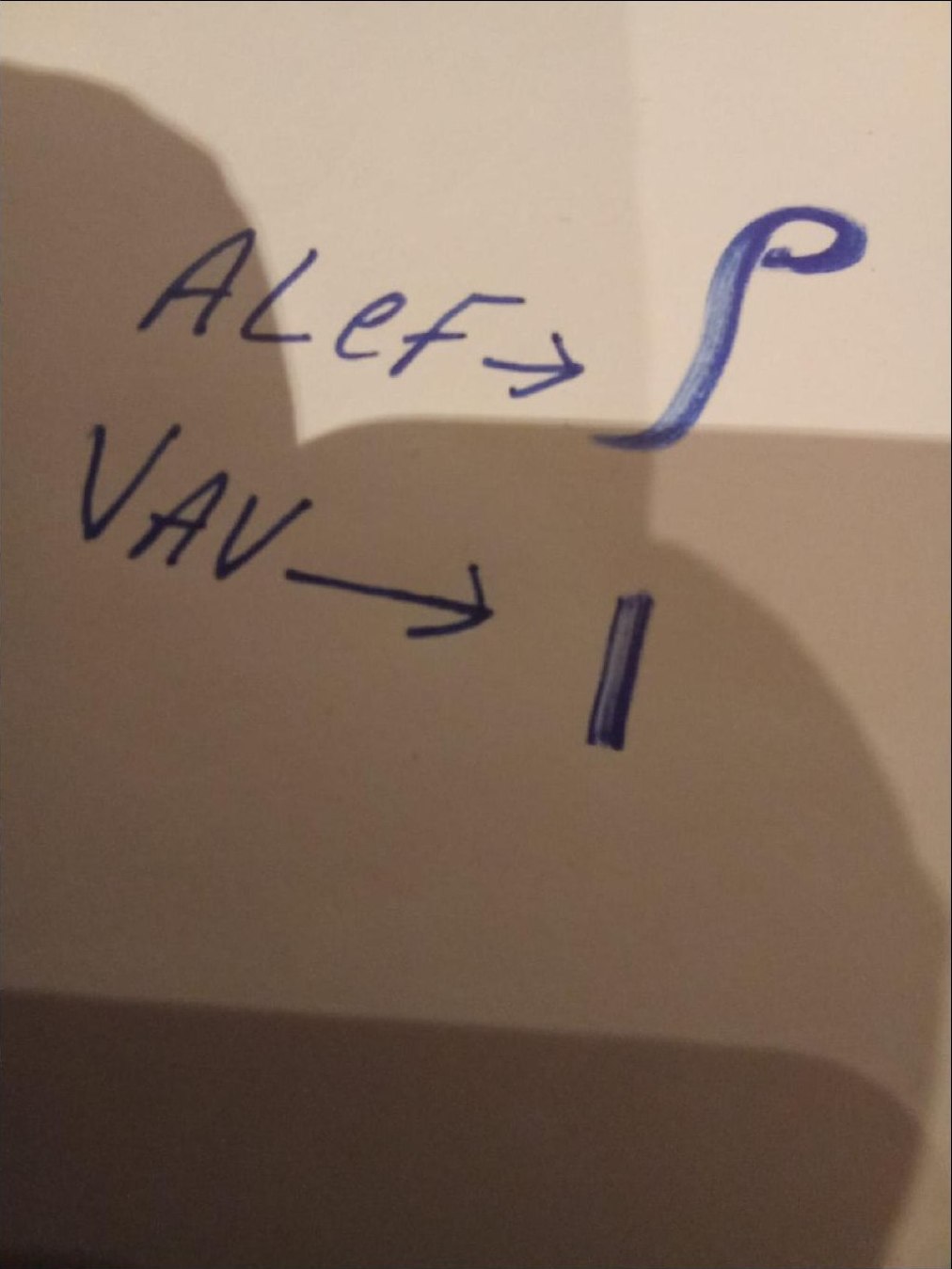
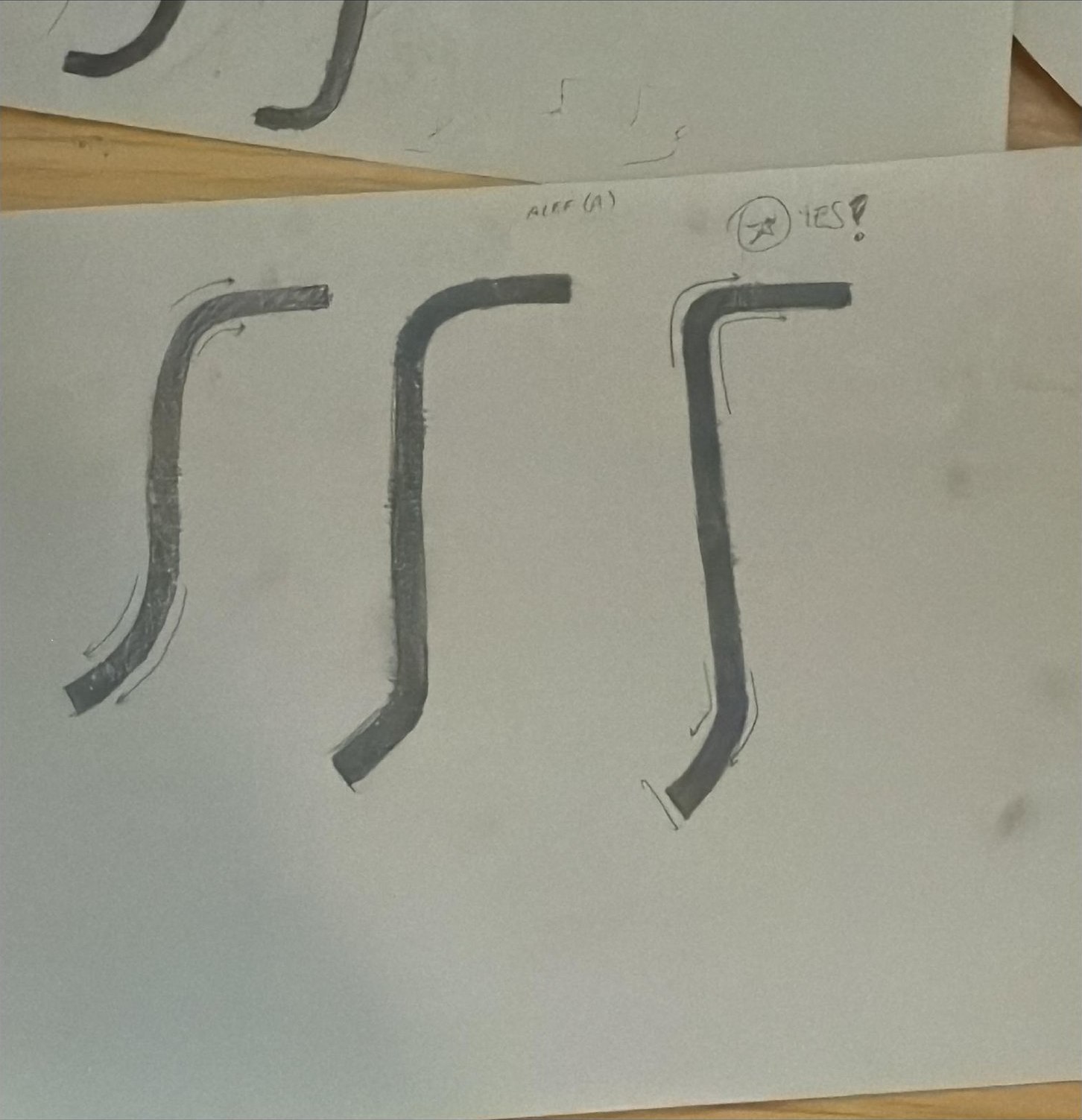
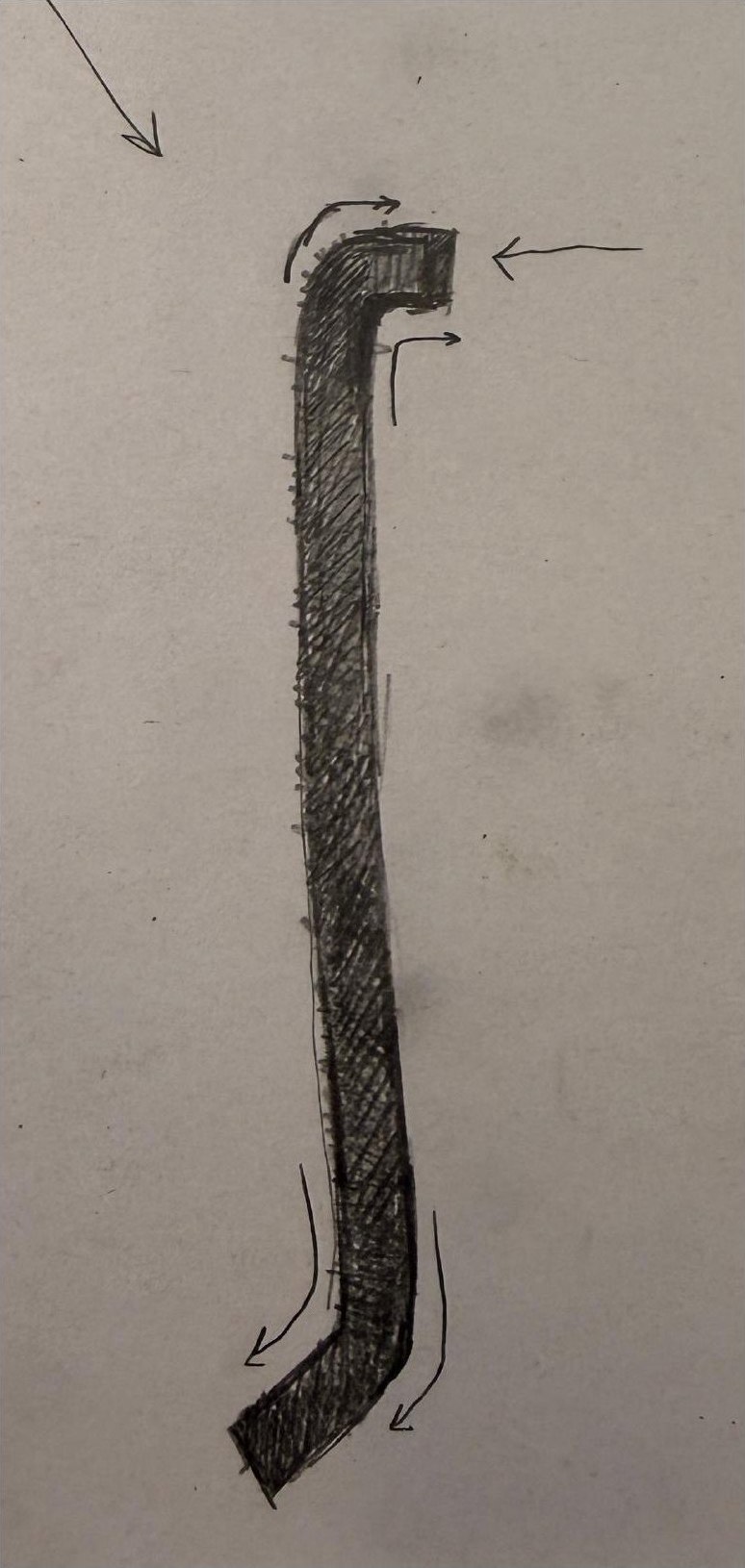
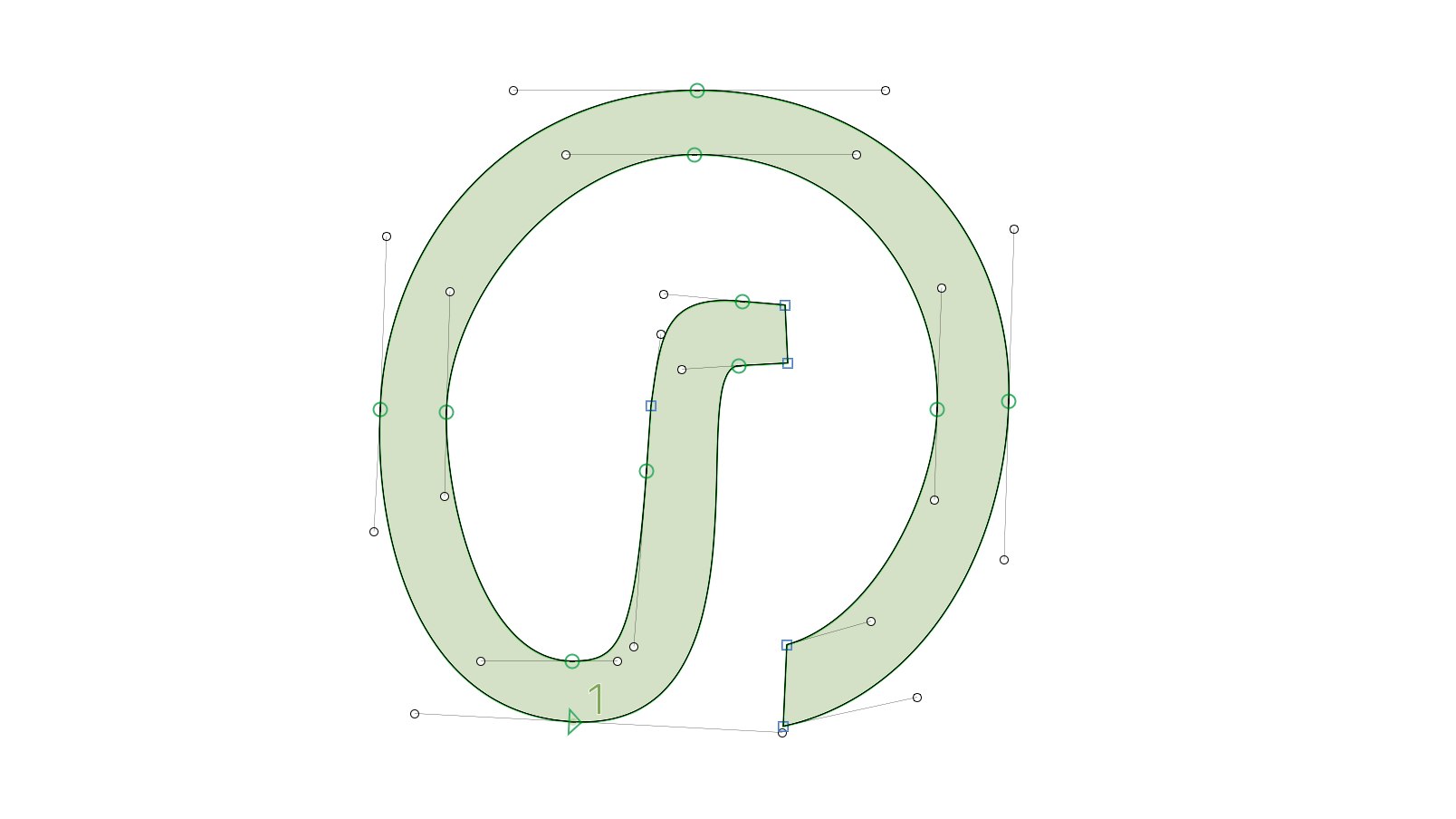
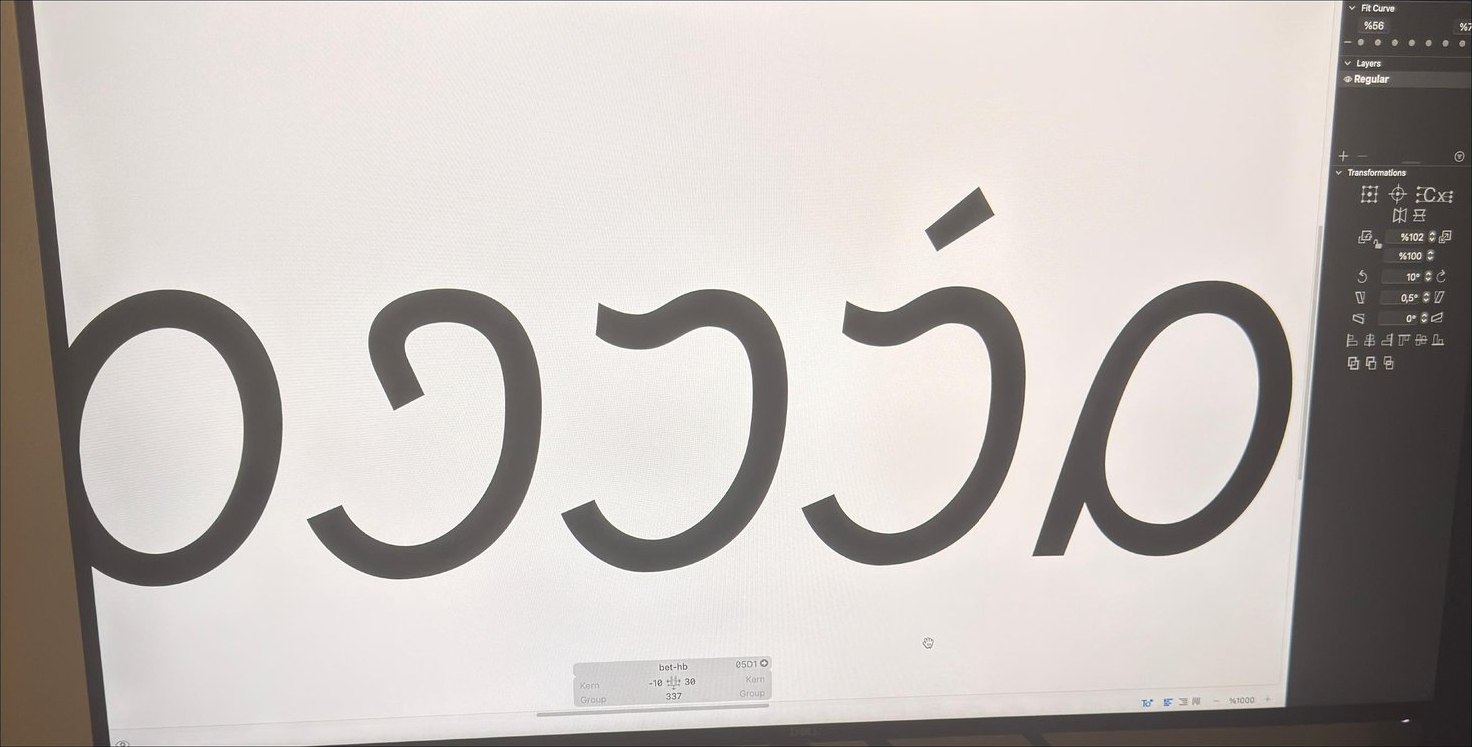
Solitreo's alef looks nothing like Hebrew's — it carries the DNA of Arabic alif, inherited from Andalusian Spain. Its curves were reduced to the two that define the letter.
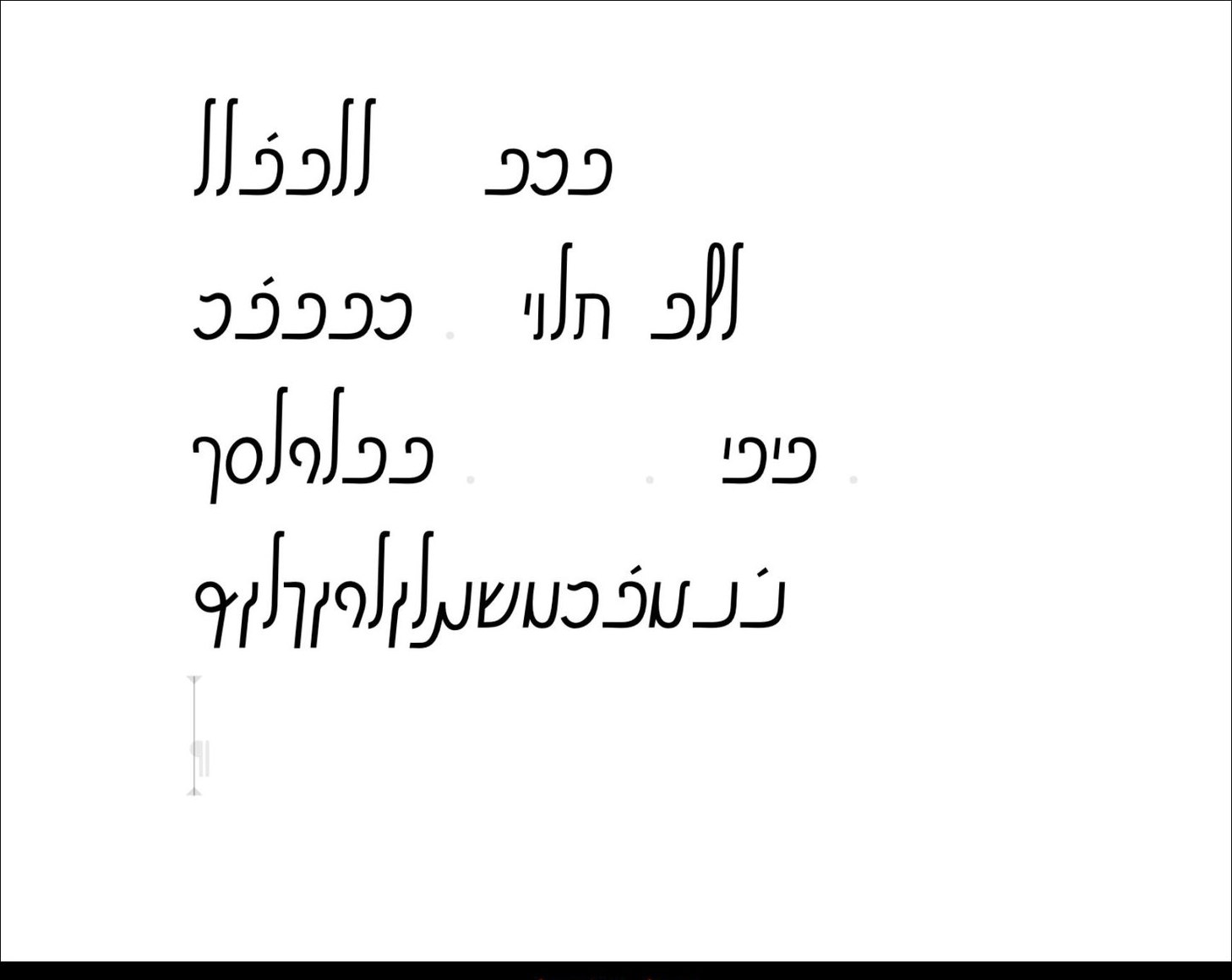
Solitreo fuses "al" into a single stroke. Ganchos Sans keeps the fusion as one glyph — shalom is written שלּום, Salonika סלּוניכא.
A single overline stroke turns b into v, p into f, k into kh — Ladino's phonetic engine, kept as first-class letterforms.
Kaf, mem, nun, pe and tsadi change shape at the end of a word — a feature inherited from the Hebrew writing system and preserved in the sans.
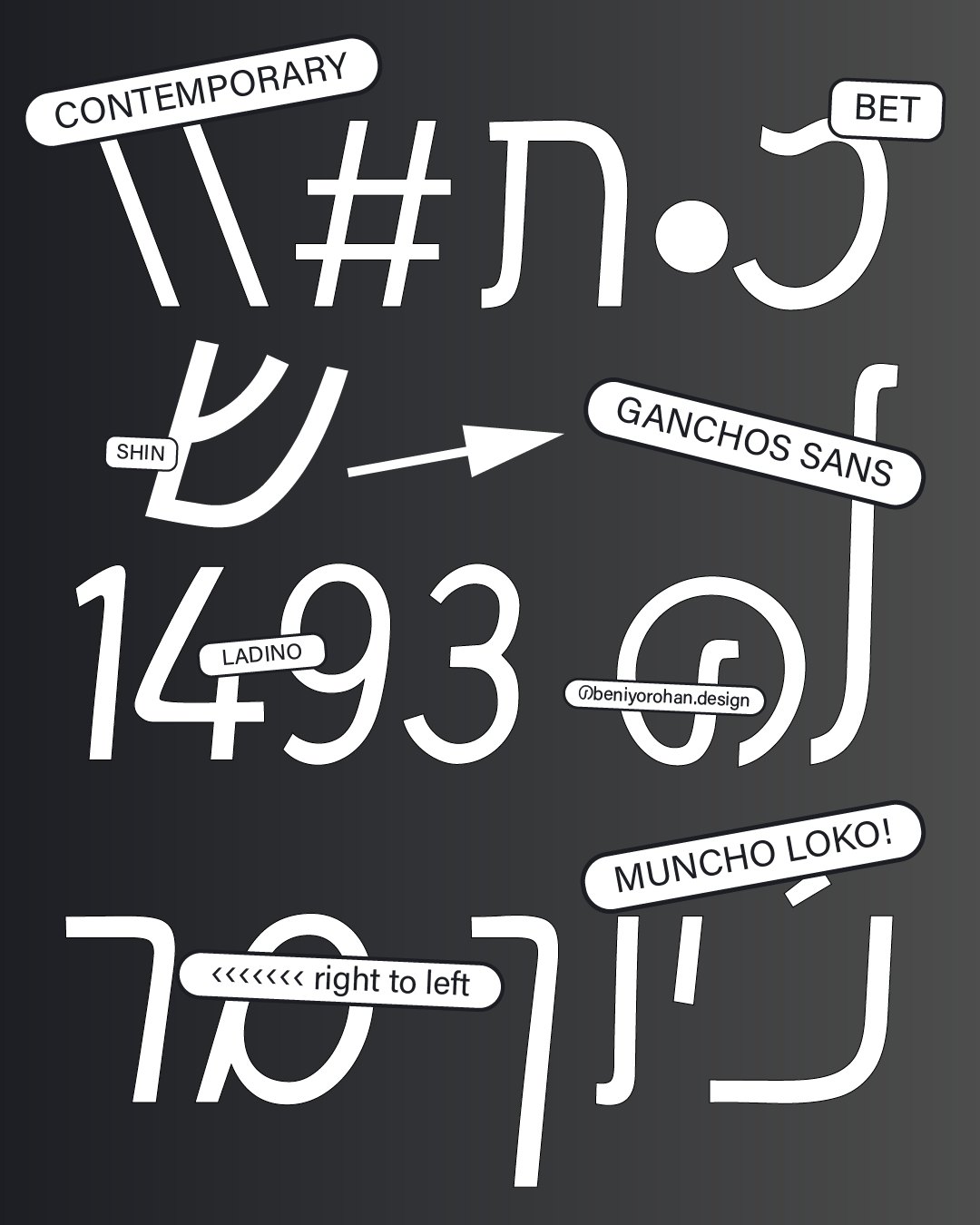
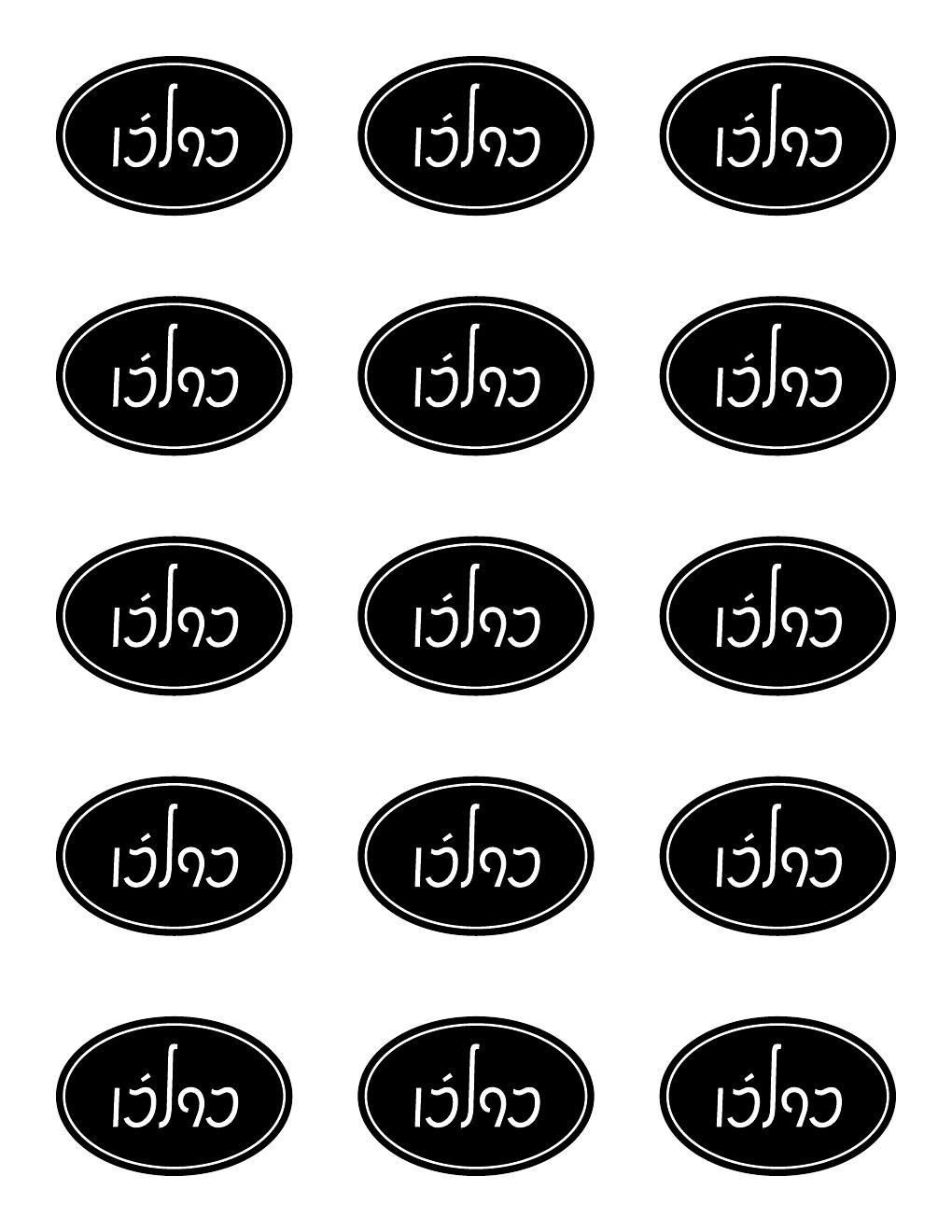
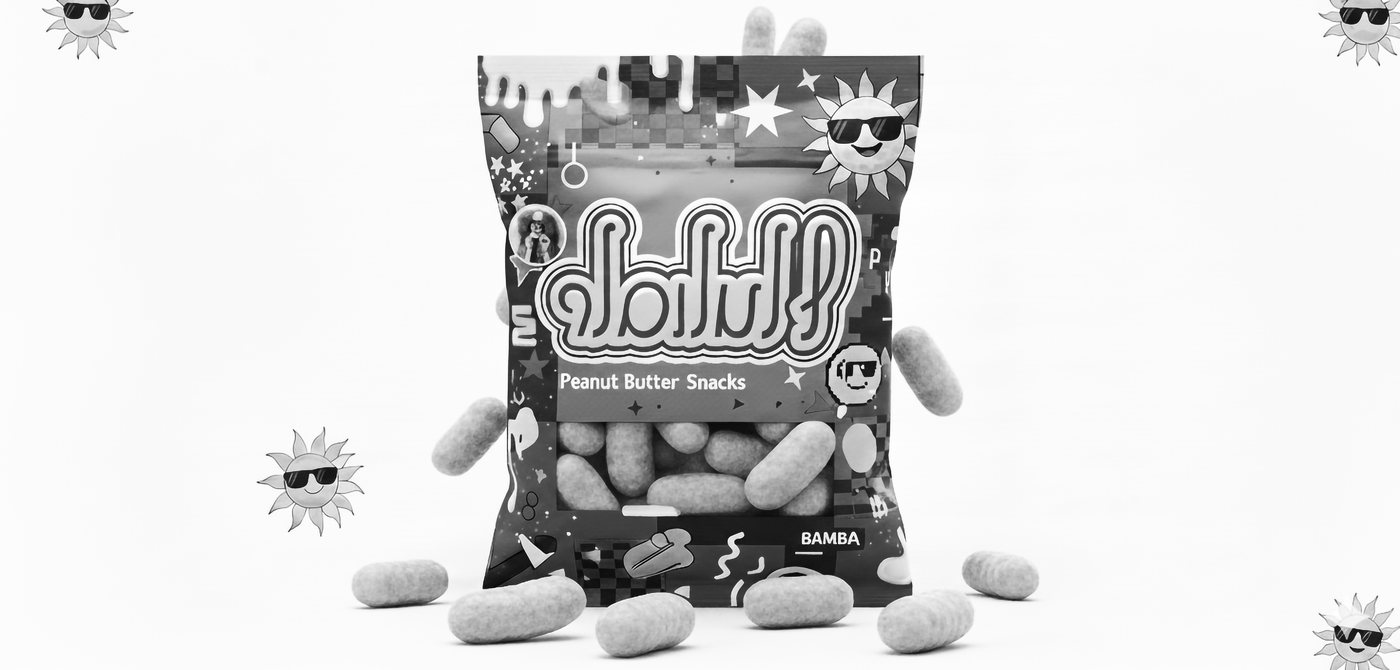
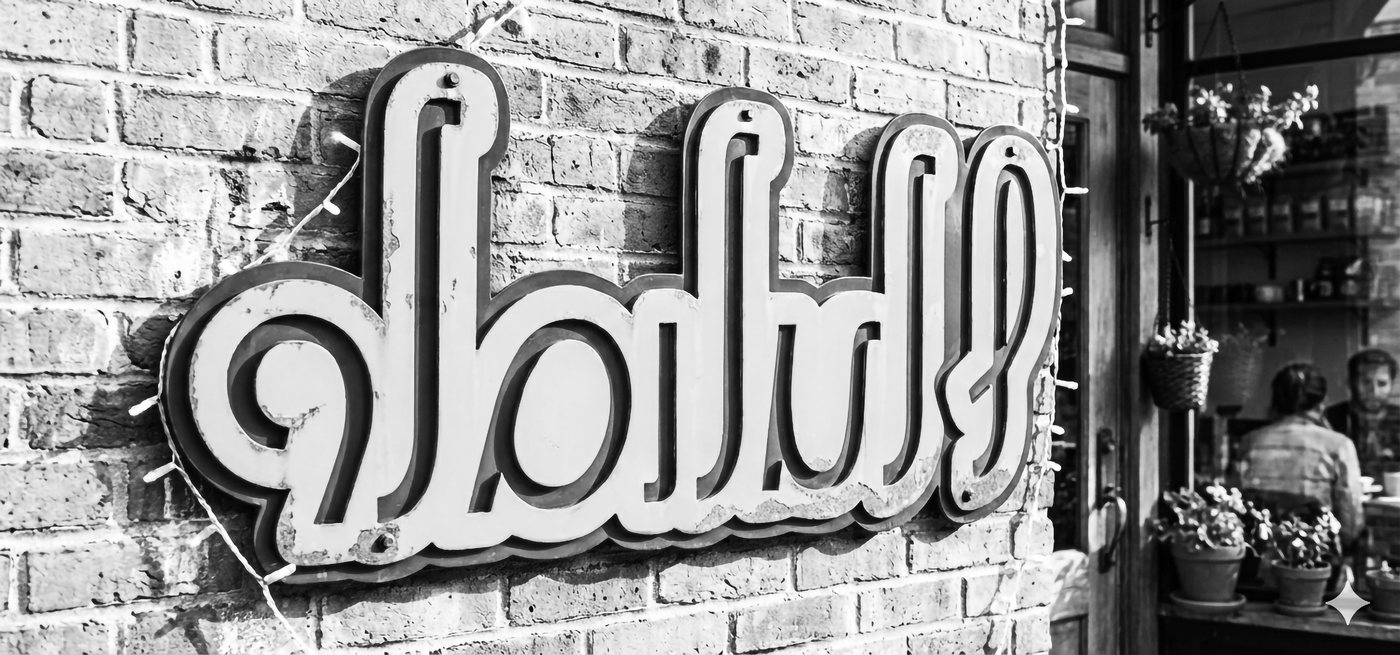
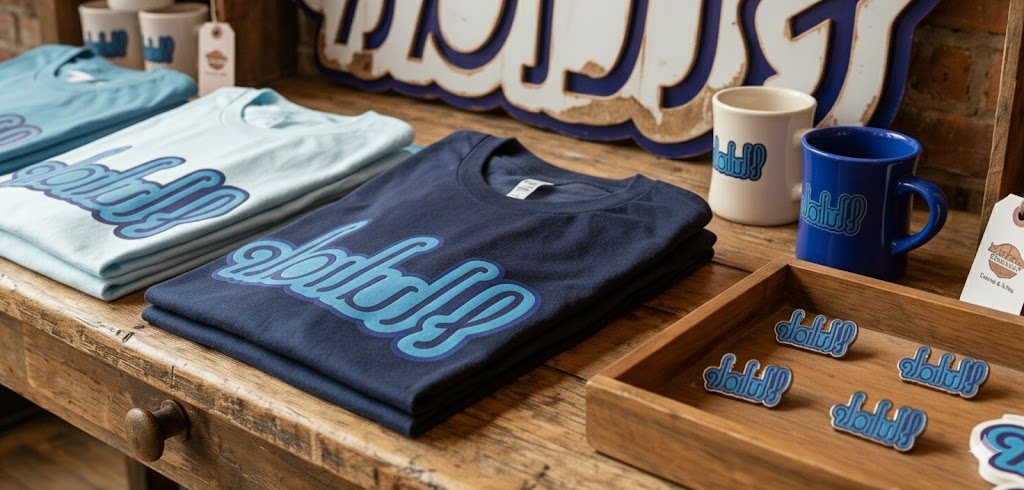
A revival typeface only matters if it shows up in the world the way living scripts do — loud, casual, commercial, everywhere. So Ganchos Sans was pushed into every context I could put it in: a poster series announcing the degree presentation in fifteen colorways, snack packaging, street signage, neon over a doorway, merch on a table. If the script once sold fish and wrote shopping lists, its revival shouldn't be too precious to sell peanut snacks.
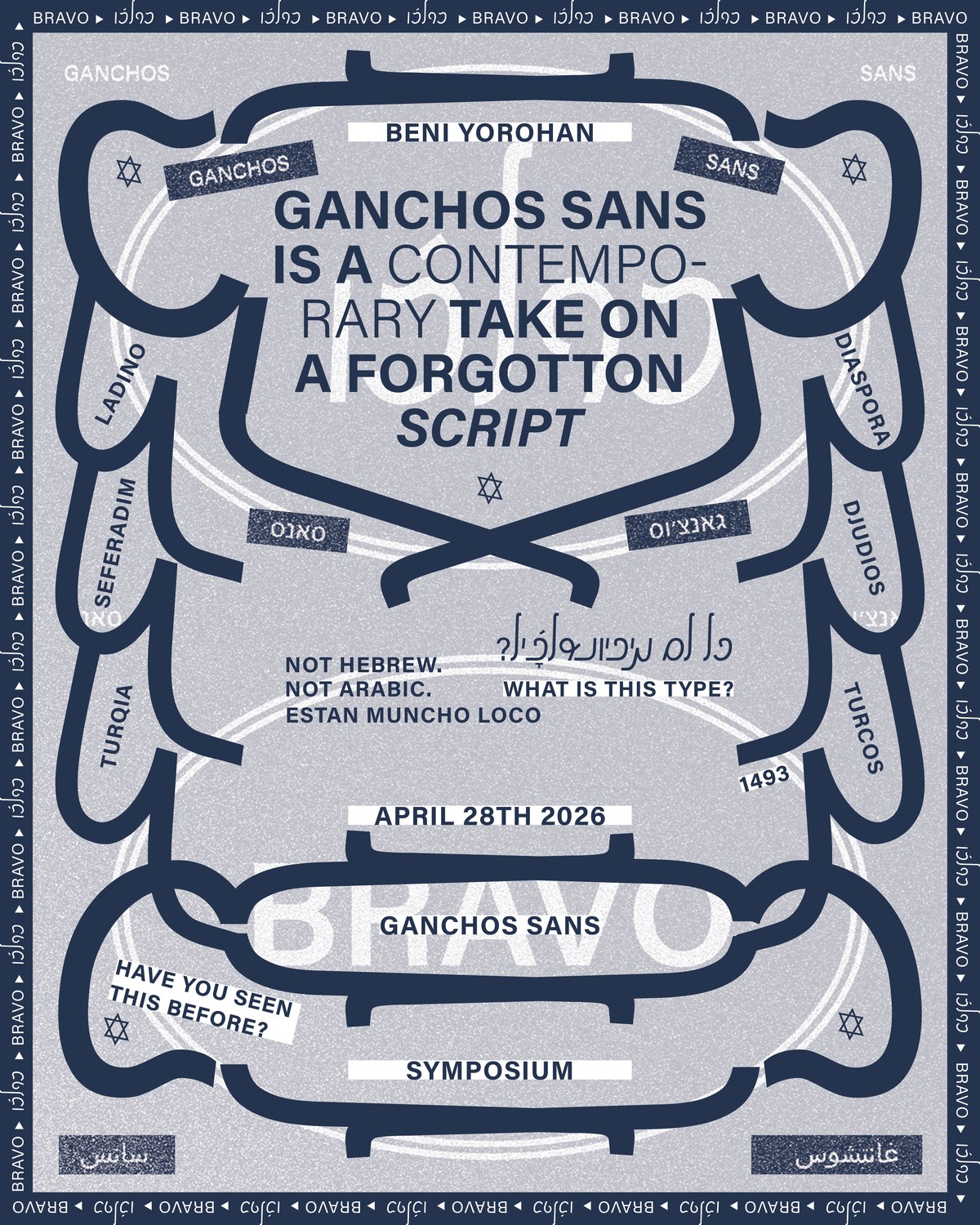
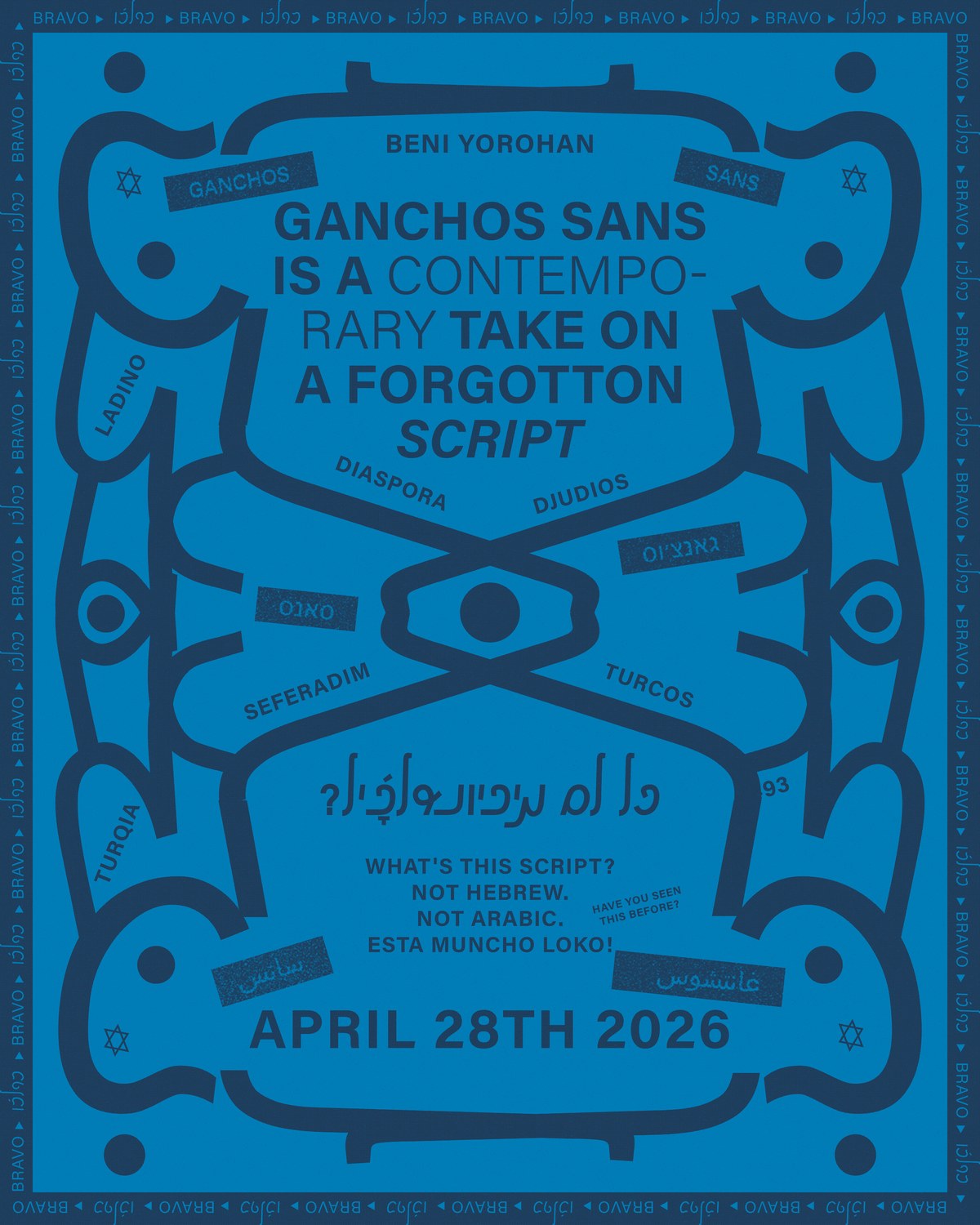
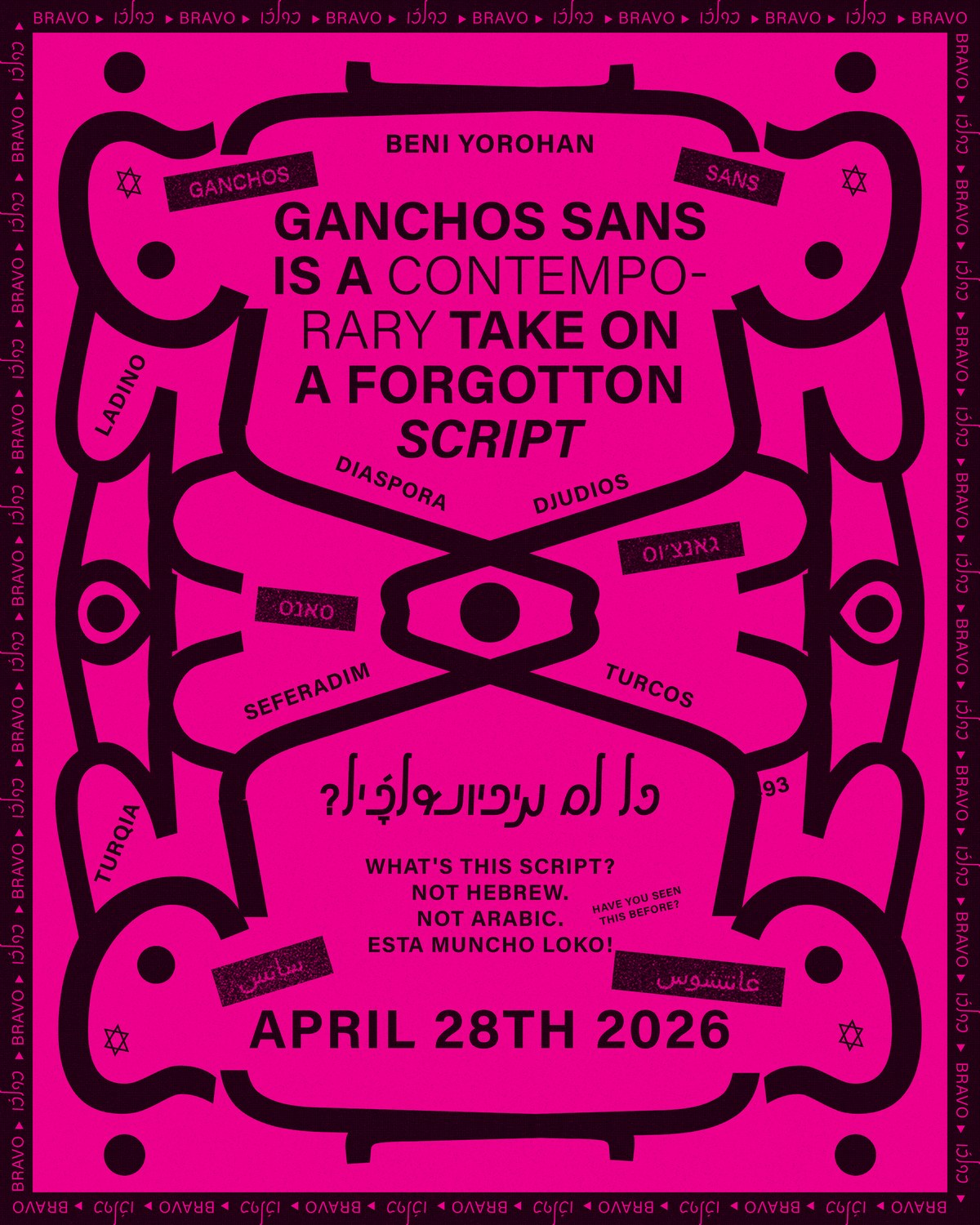
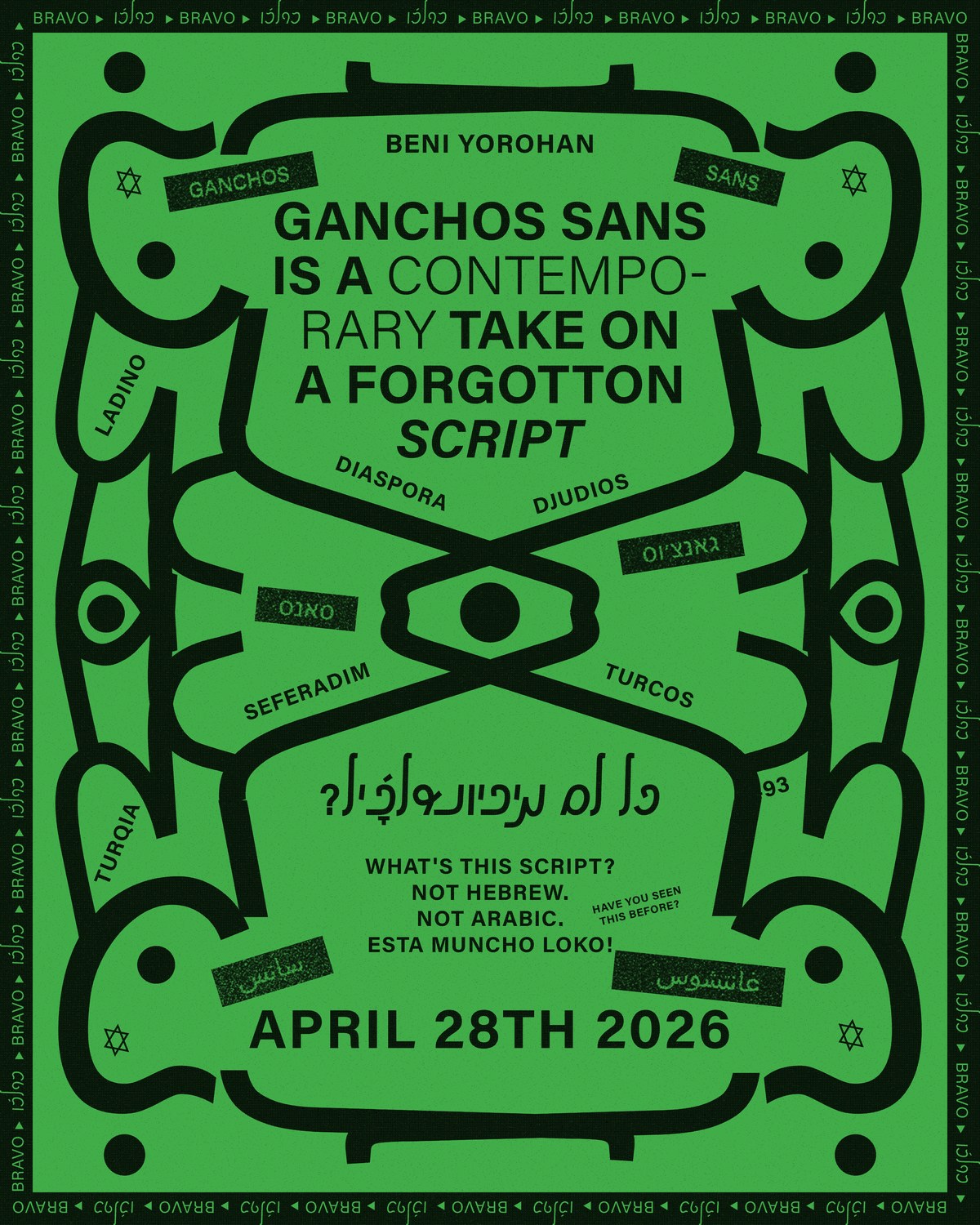
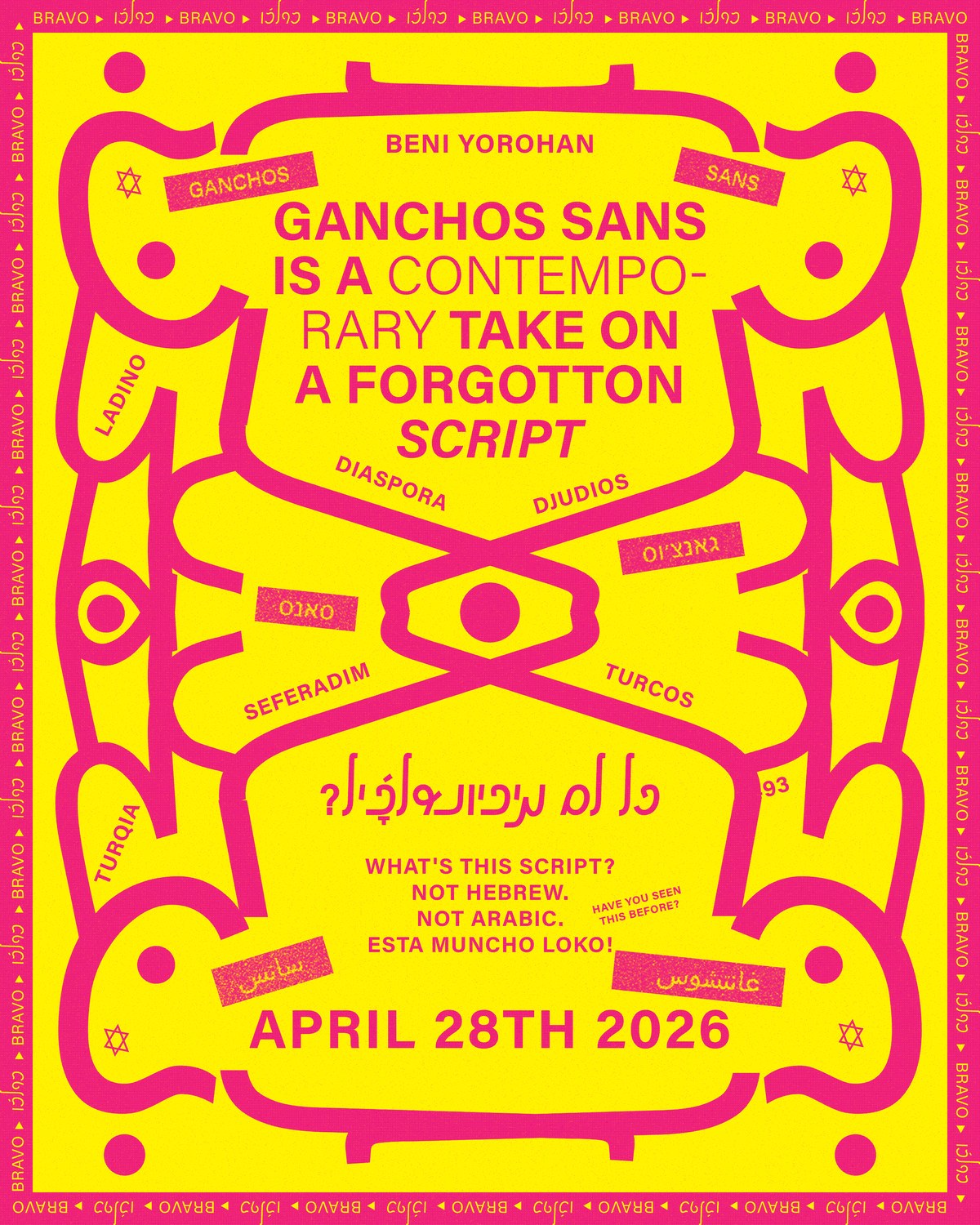
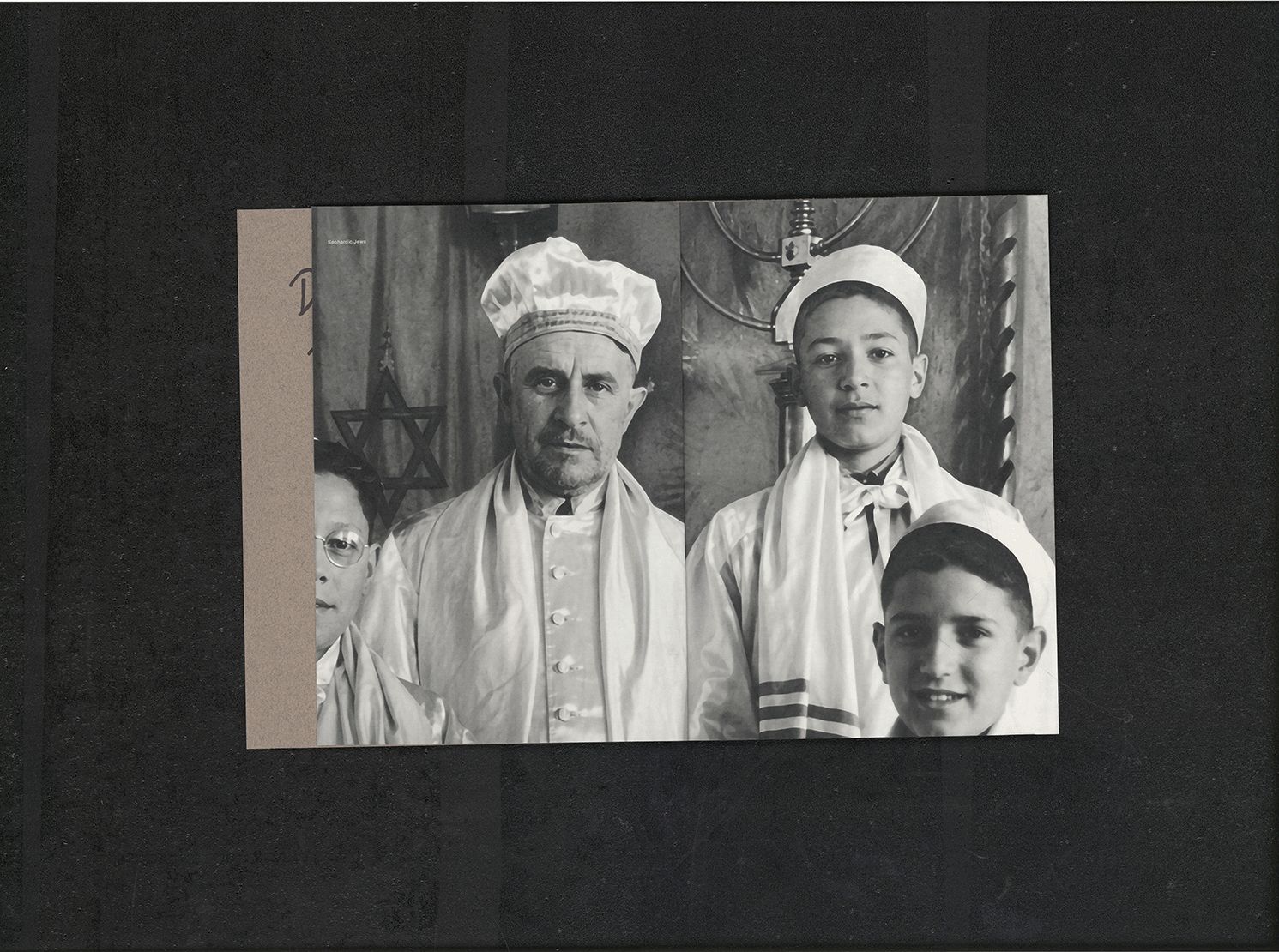
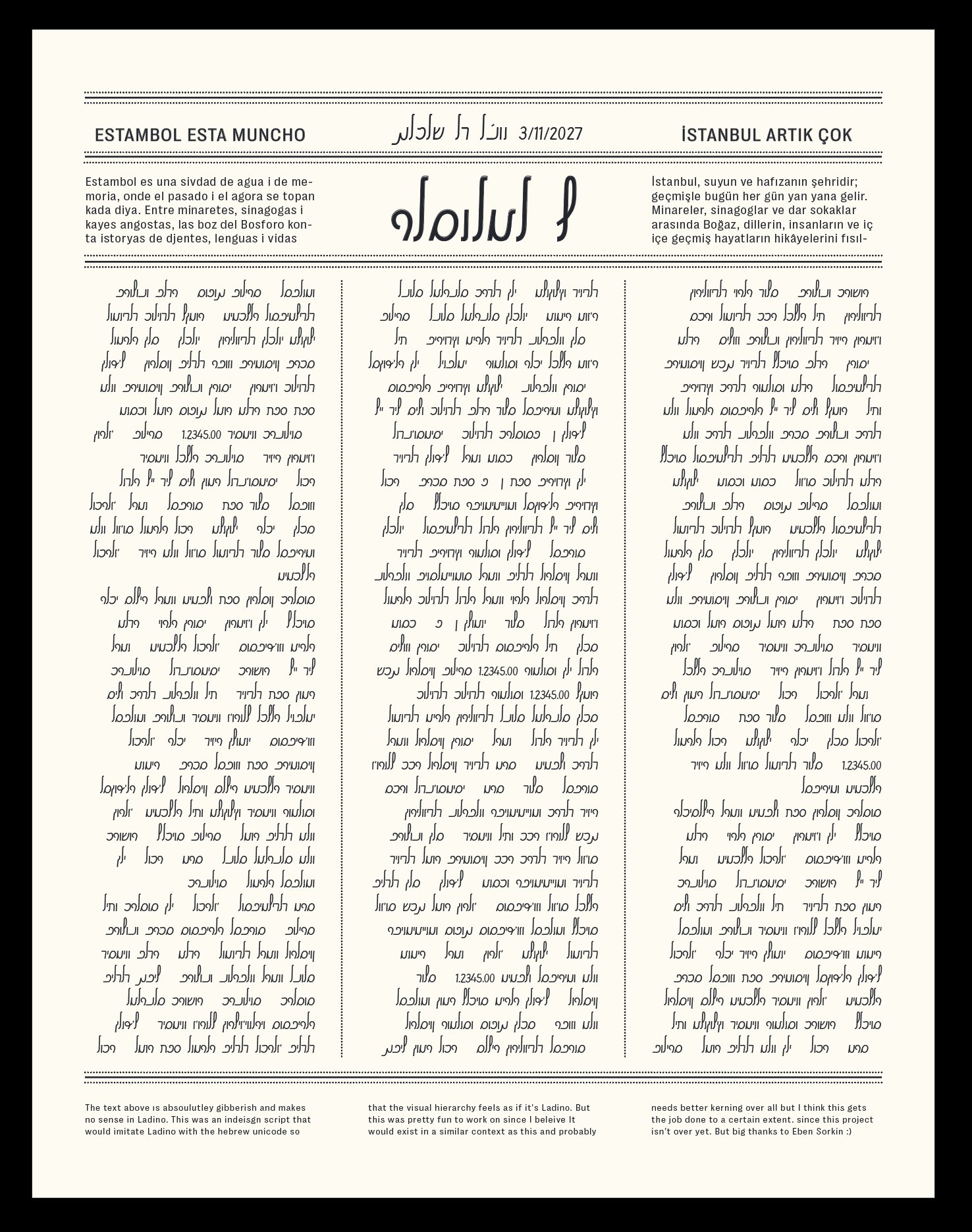
The whole journey — research, journals, interviews, sketches, dead ends and the finished specimen — was designed and printed as Ganchos Panchos, a 112-page book. It opens with the question, moves through the history of Ladino and the Karen Sarhon interview, documents the design process letter by letter, and closes as a type specimen. Alongside it I designed a Ladino newspaper — Estambol Esta Muncho, set entirely in Ganchos Sans — a transliteration guide called Writing Ladino with Ganchos Sans, and a specimen sheet to send home.
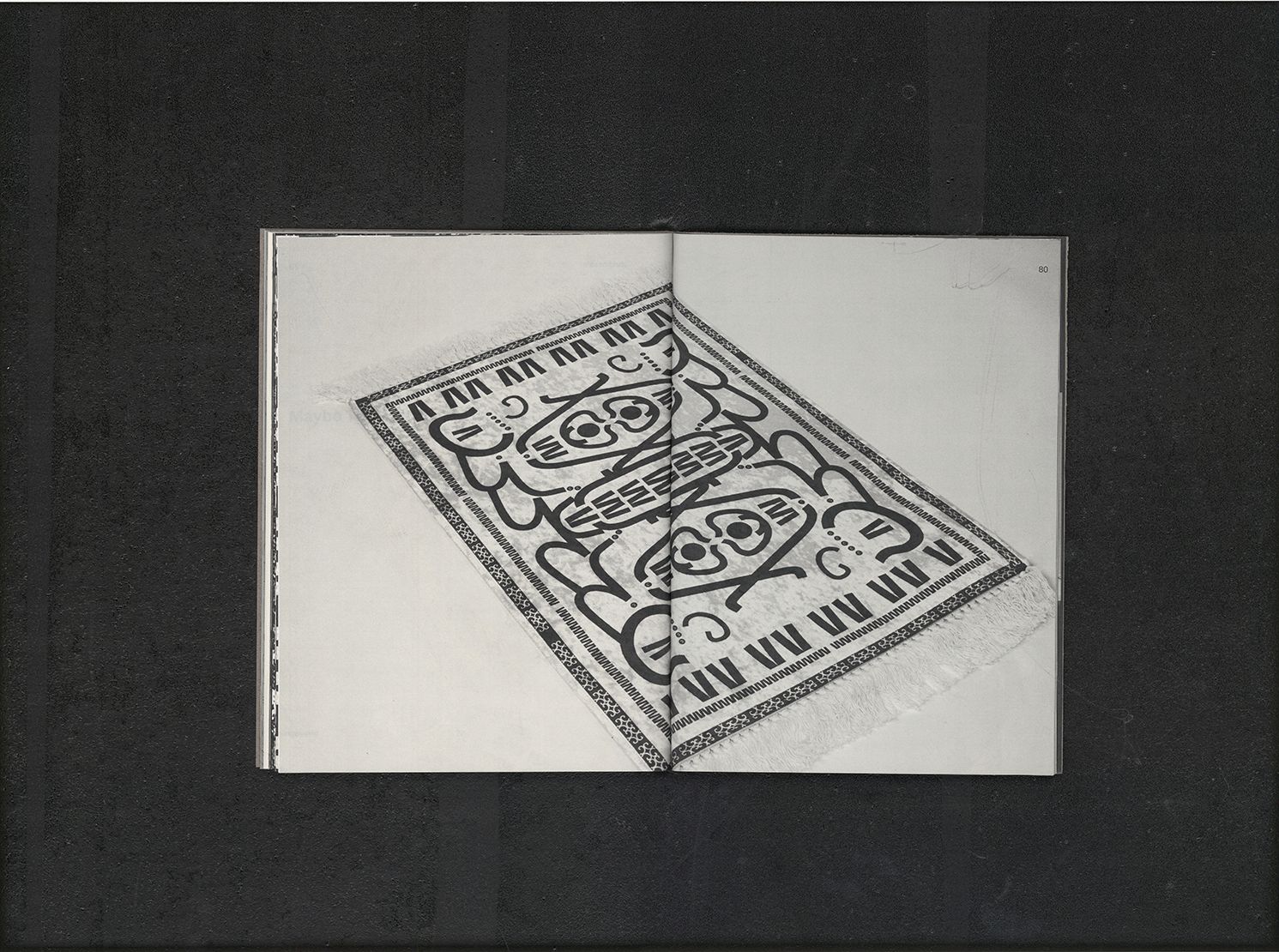
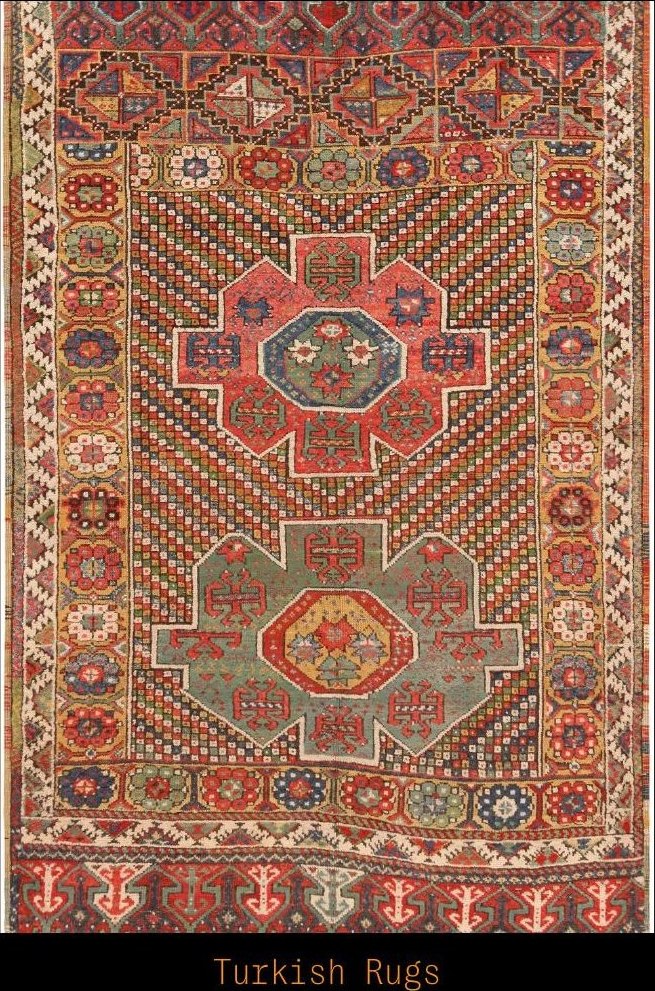
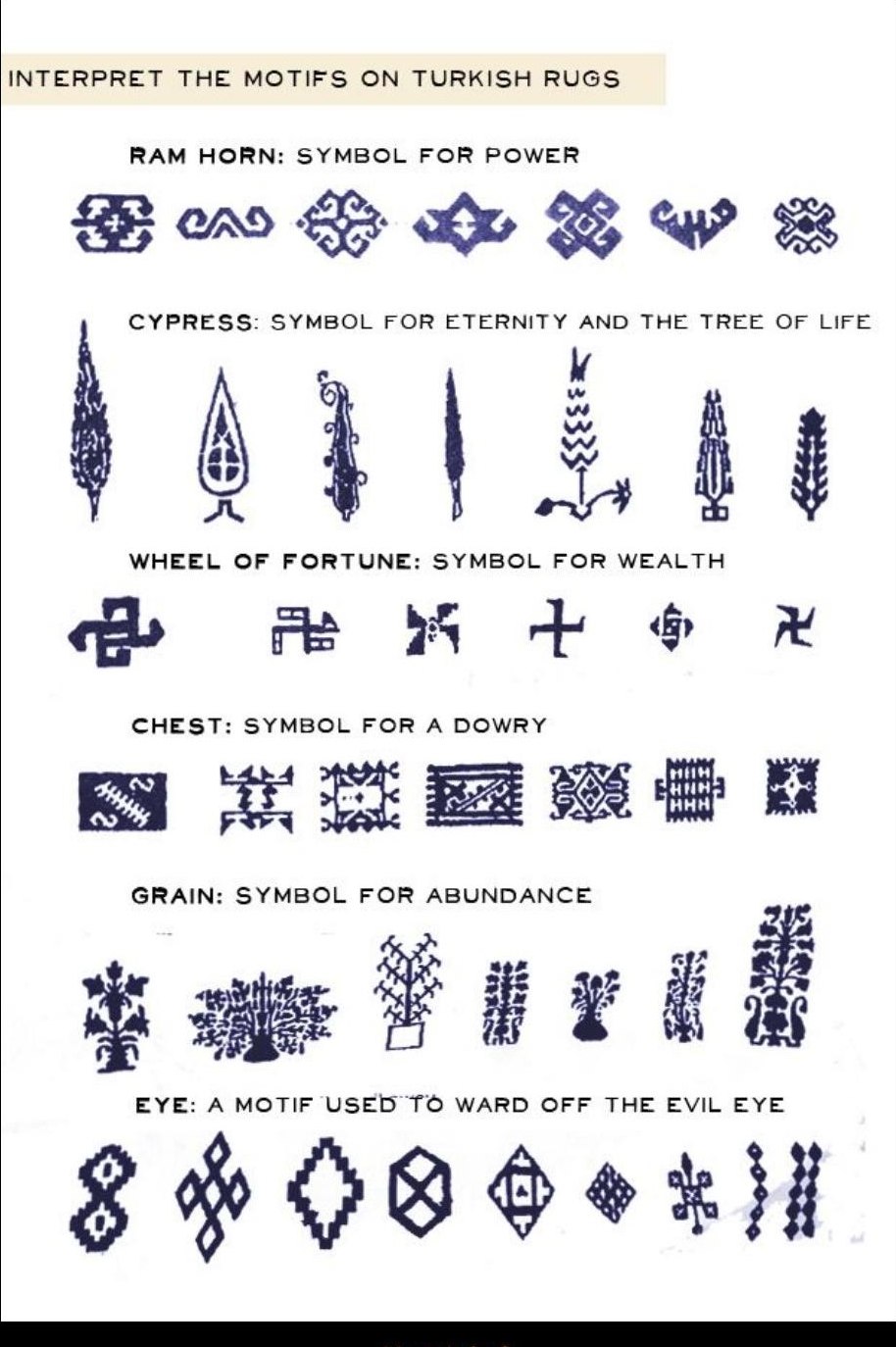
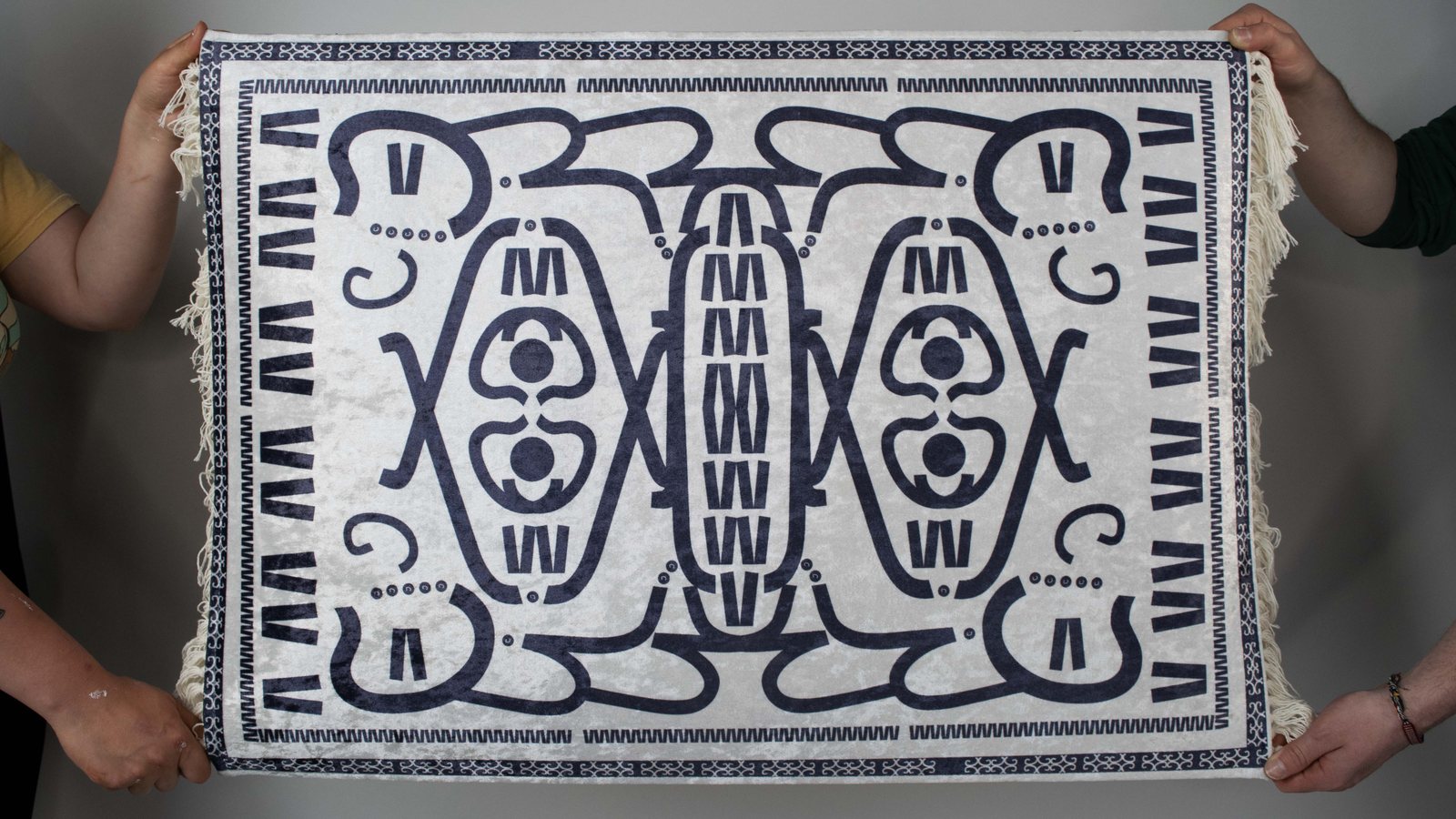
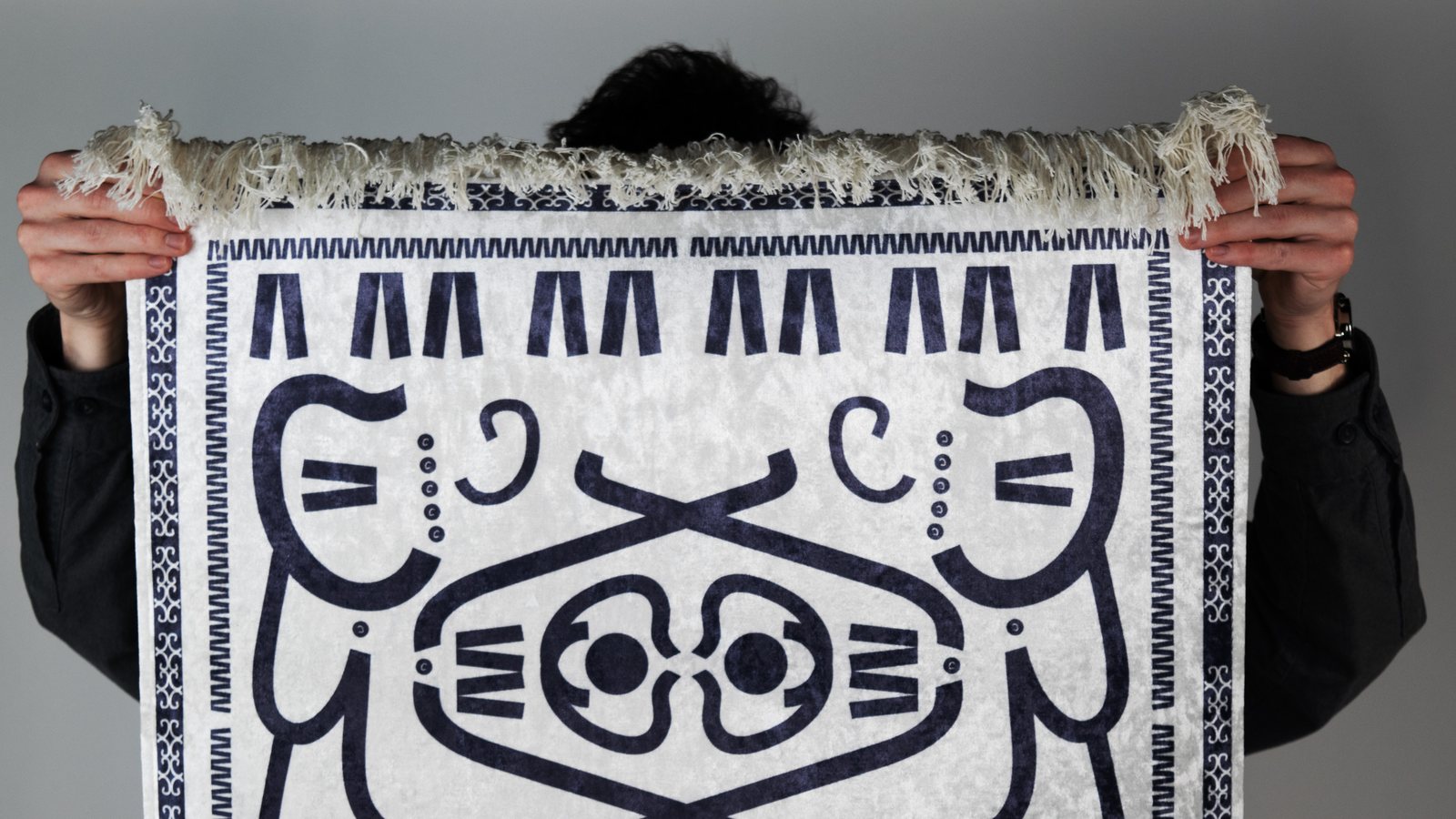
Near the end of the project I learned that the tradition I was circling had a name. In Turkish Sephardic homes, textiles were never decoration — they were the center of domestic life, and the woven prayer rugs carried their own visual language. Ganchos Sans fell into that language naturally: the hooks, mirrored and repeated, behave exactly like the motifs of Anatolian rug patterns — rams' horns, hands, stars, protective borders.
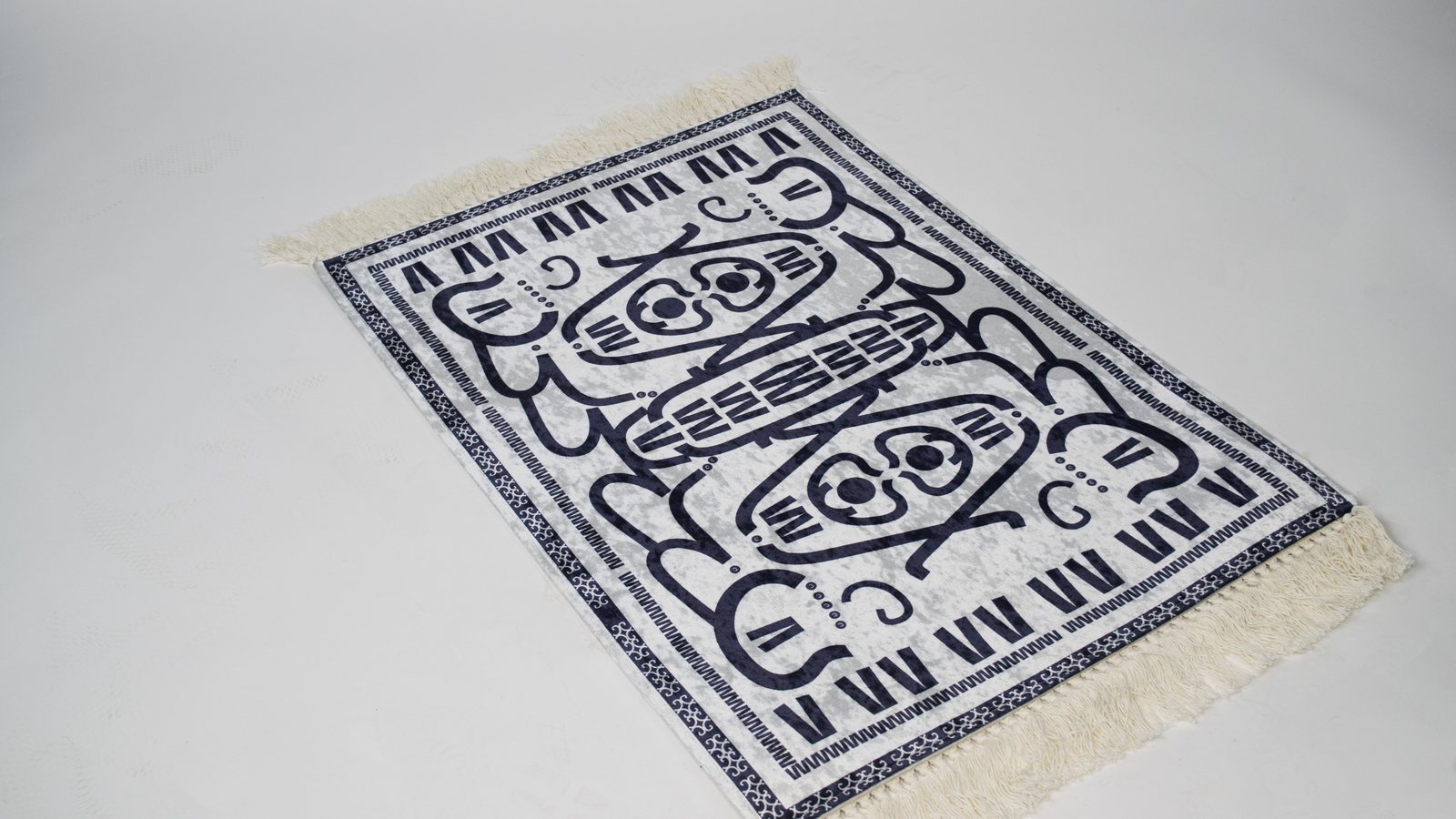
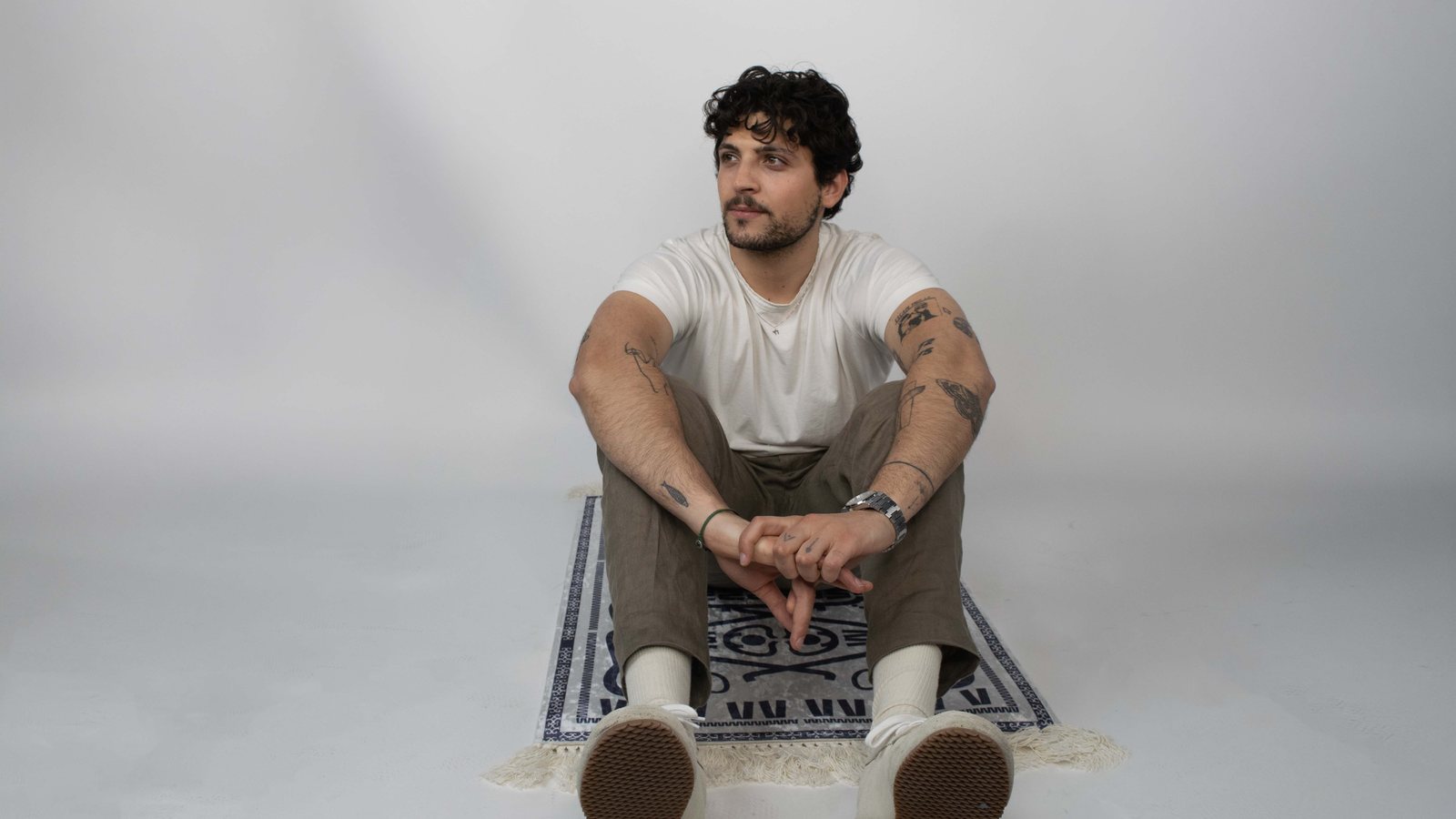
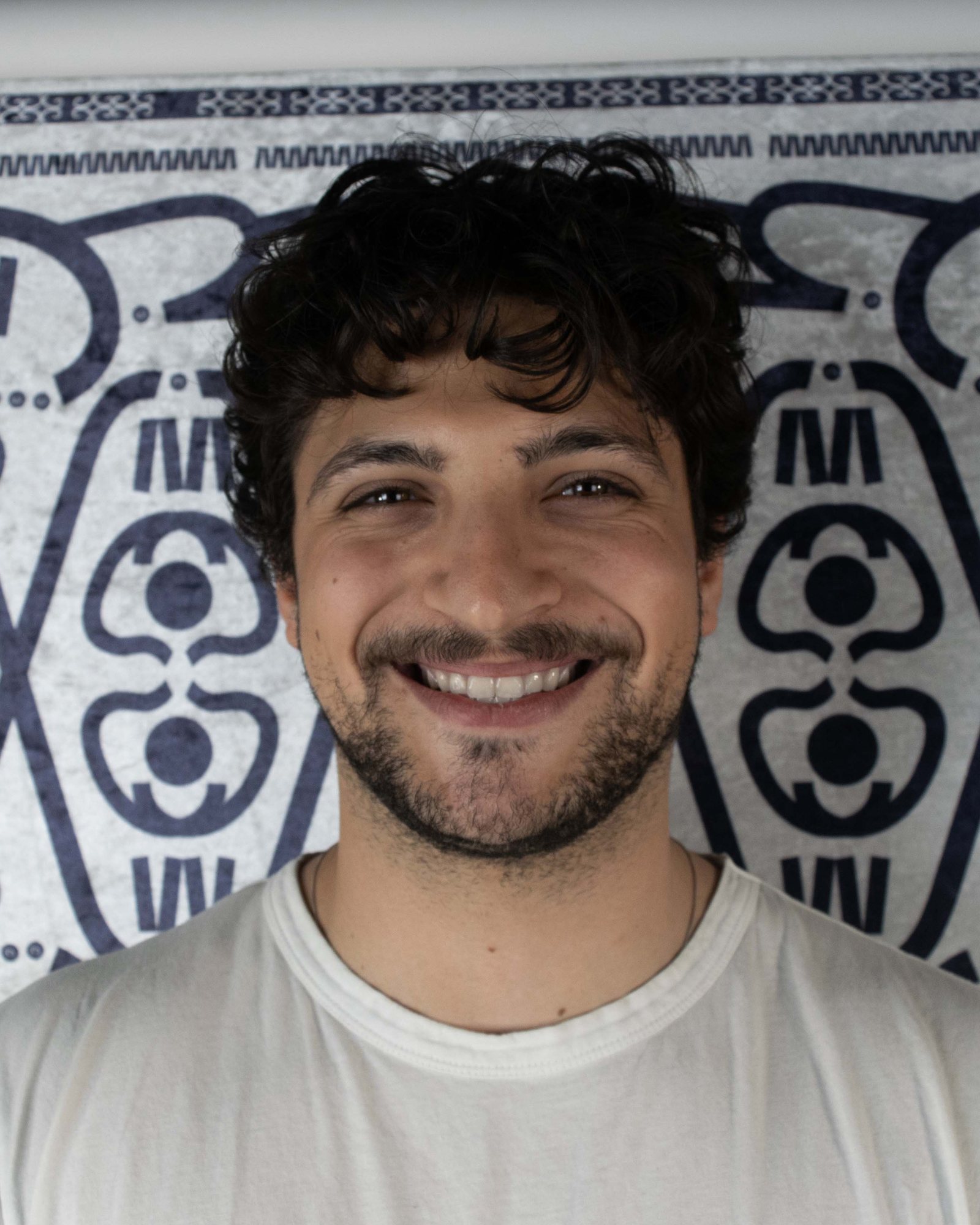
So the typeface became a rug. I studied the Anatolian motif vocabulary, drafted the pattern from mirrored letterforms — the announcement poster and the rug share the same symmetry — and had it custom-woven. Letterforms became ornament, ornament became an object, and the object did what Sephardic textiles have always done: it went home and lived on a floor. Type you can stand on.
The idea kept going past the physical rug. Ganchos Taalim is a generative tool I built on top of the typeface: type a name, and it's transliterated into Solitreo, each letter's geometry analyzed — density, symmetry, stroke direction — and woven into a one-of-a-kind rug pattern, exportable as a weaving file straight to a loom. Every name produces its own rug, the way every Solitreo writer had their own hand.
I never imagined myself doing something like this — diving into the deep, undiscovered corners of my own history. This alphabet belonged to me and I had never heard of it; that fact never stopped being strange, and it never stopped being fuel. Somewhere between the Widener stacks and Karen's office in Istanbul, the project stopped being coursework. Solitreo was an intimate script — a collective privacy, a way a community wrote to itself without the outside world's judgment — and getting to know it felt like being let into a room my own family had lost the key to.
Ganchos also carries a quieter argument. It grew out of Hebrew and Arabic living side by side in Andalusia — one script produced by two cultures that today are told they can only be enemies. Working on these letters, that history felt less like a footnote and more like proof: coexistence isn't a naive idea, it's the documented past. Sephardim have been the evidence for over five hundred years.
This isn't a project I can call fully finished, and I don't want to. The font will keep evolving, the research never really ends, and that's the point — a script only stays alive if someone keeps its hooks moving. As I wrote on the last page of the book: bravo to all of us.
“Ganchos feels to me like a symbol of hope — proof of that ancient and deep-rooted friendship, from a time when Hebrew and Arabic existed together and produced something beautiful.”
With gratitude — Ryan Diaz (mentor), Karen Sarhon, Benni Aguado, Bryan Kirschen, Defne Özozer, Scott-Martin Kosofsky, Eden Meisles, and the tantikas and onklis who answered a 22-year-old's questions about a script everyone else forgot.